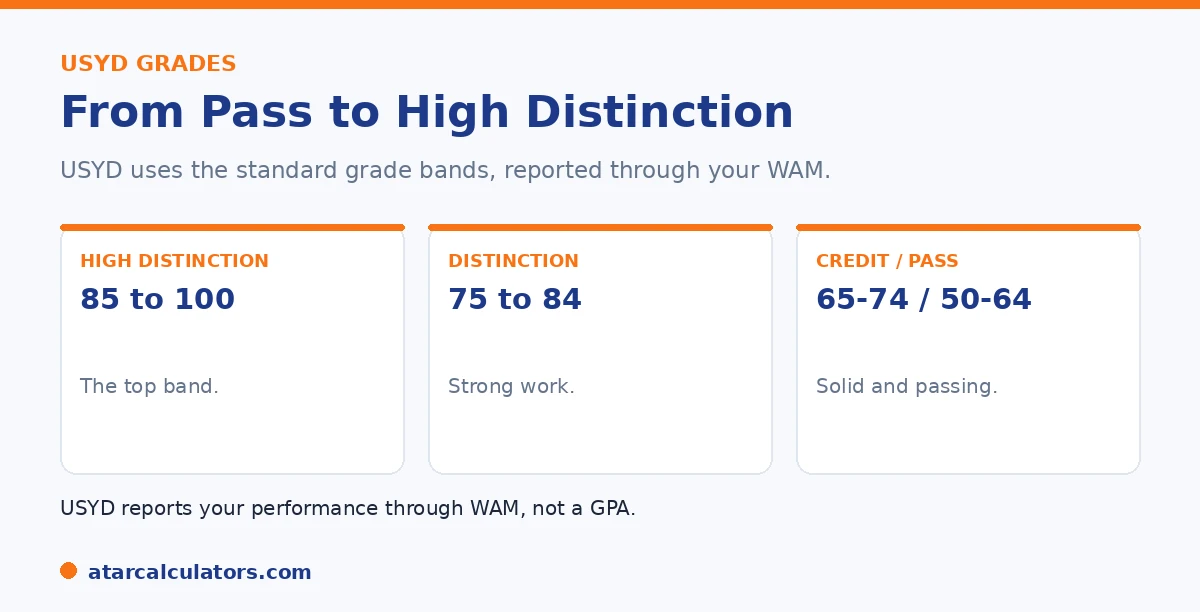
Here is the short version. The University of Sydney uses five grades: High Distinction for marks of 85 to 100, Distinction for 75 to 84, Credit for 65 to 74, Pass for 50 to 64, and Fail for 0 to 49. Your overall performance across units is summed up by the WAM, or Weighted Average Mark, which is Sydney's official measure rather than a GPA.
If you are new to Sydney, the grade names can be confusing at first, especially the bands behind each one. They are simpler than they look.
Below is the full grading system. To track your average, use our USYD calculator.
Key takeaways
- High Distinction is a mark of 85 to 100.
- Distinction is 75 to 84.
- Credit is 65 to 74.
- Pass is 50 to 64, and Fail is 0 to 49.
- Your overall result is summed up by the WAM.
- Sydney uses the WAM, not a GPA, as its official measure.
The five grades
Sydney uses five grades, each tied to a mark range. Here they are in full.
| Grade | Mark range | Grade points (7-point) |
|---|---|---|
| High Distinction (HD) | 85 to 100 | 7 |
| Distinction (D) | 75 to 84 | 6 |
| Credit (CR) | 65 to 74 | 5 |
| Pass (PS) | 50 to 64 | 4 |
| Fail (FA) | 0 to 49 | 0 |
Sydney uses these grades with the WAM. The grade points shown are for an unofficial GPA estimate on a common 7-point scale, not an official Sydney figure.
So the grade you get for a unit depends only on your mark falling into one of these bands. A mark of 85 or more is a High Distinction, the top grade, while 50 to 64 is a Pass.
High Distinction and Distinction
The top two grades are the ones students aim for. A High Distinction, for marks of 85 and above, is the highest grade and signals excellent work. A Distinction, for marks of 75 to 84, is a strong result in its own right.
An average in the distinction band or above is well regarded, and supports honours and scholarship applications. See our guide on the distinction average.
How your grades add up
Individual grades describe single units. Your overall performance across your degree is summed up by the WAM, Sydney's official measure. It is the credit-weighted average of your actual marks, out of 100.
Note that Sydney uses the WAM, not a GPA. So while you get grades for units, your headline figure is your WAM. See our guide on whether Sydney uses WAM or GPA.
Want to track your average?
Try the USYD calculator →Repeating and failed units
A few rules are worth knowing. A Fail, for a mark below 50, counts toward your WAM at its actual mark, which can pull your average down. Sydney does allow students to repeat units, and grade replacement rules can apply in some cases.
These details can vary by faculty and change over time, so check your own faculty's rules. See our guide on why a WAM can drop.
Why the bands matter
Knowing the bands helps you read your results clearly. A mark of 74 and a mark of 75 sit one point apart but fall in different grades, Credit and Distinction, so small differences can cross a boundary.
That is useful to know when a mark is borderline, since nudging it across a band can matter for how your result reads. See our guide on what counts as a good result at Sydney.
The bands matter more than they first appear, because so much downstream depends on which side of a boundary a mark lands. Two consequences stand out. First, for anything grade-based, a boundary is a genuine step change: a 74 and a 75 differ by a single mark but sit in different grades, and where results are read as grades, that one mark can change how your record looks and, on a grade-point scale, nudge your GPA. Second, near honours and graduation thresholds, boundaries can decide a classification, so a mark pushed from just below to just above a band can carry real weight. This gives you a concrete, efficient way to direct effort late in a session. Rather than spreading revision evenly, identify the units where your predicted mark is hovering a point or two below a band, and concentrate there, since crossing the boundary yields more than the same effort in a unit already settled mid-band. It also flags where a small slip is costly: a mark that drops just under a boundary loses a grade for the sake of a point. Knowing exactly where Sydney's bands fall, and watching your borderline units against them, turns the grade scale from something you passively get into something you can steer, protecting the results that determine how your record reads and what thresholds you clear.
Common questions
What grades does the University of Sydney use?
Five: High Distinction for marks of 85 to 100, Distinction for 75 to 84, Credit for 65 to 74, Pass for 50 to 64, and Fail for 0 to 49. Your overall performance is summed up by the WAM, Sydney's official measure.
What mark is a High Distinction at USYD?
A mark of 85 or above. High Distinction is Sydney's top grade, signalling excellent work. The next grade down, Distinction, is for marks from 75 to 84, which is also a strong result.
Does USYD use a GPA?
No. Sydney uses the WAM, or Weighted Average Mark, as its official measure, not a GPA. You get grades for individual units, but your overall headline figure is your WAM, the credit-weighted average of your marks.
What happens to a failed unit at USYD?
A Fail, for a mark below 50, counts toward your WAM at its actual mark, which can pull your average down. Sydney allows students to repeat units, and grade replacement rules can apply in some cases. Check your faculty's rules.
Why do the grade bands matter?
Because small mark differences can cross a boundary. A mark of 74 is a Credit and 75 is a Distinction, just one point apart. So when a mark is borderline, nudging it across a band changes how your result reads.
Track your Sydney results
See where your average sits, from your marks and credit points. Free, and no signup.
Open the USYD calculator →Related guides
This guide is general information for students, not formal academic advice. The University of Sydney's official academic metric is the WAM, and it does not issue or calculate an official GPA. Any GPA you work out is an unofficial estimate for your own use. Grade bands and honours requirements can vary by faculty and change over time, so always confirm with the University of Sydney directly. Reviewed by the ATARCalculators Editorial Team.