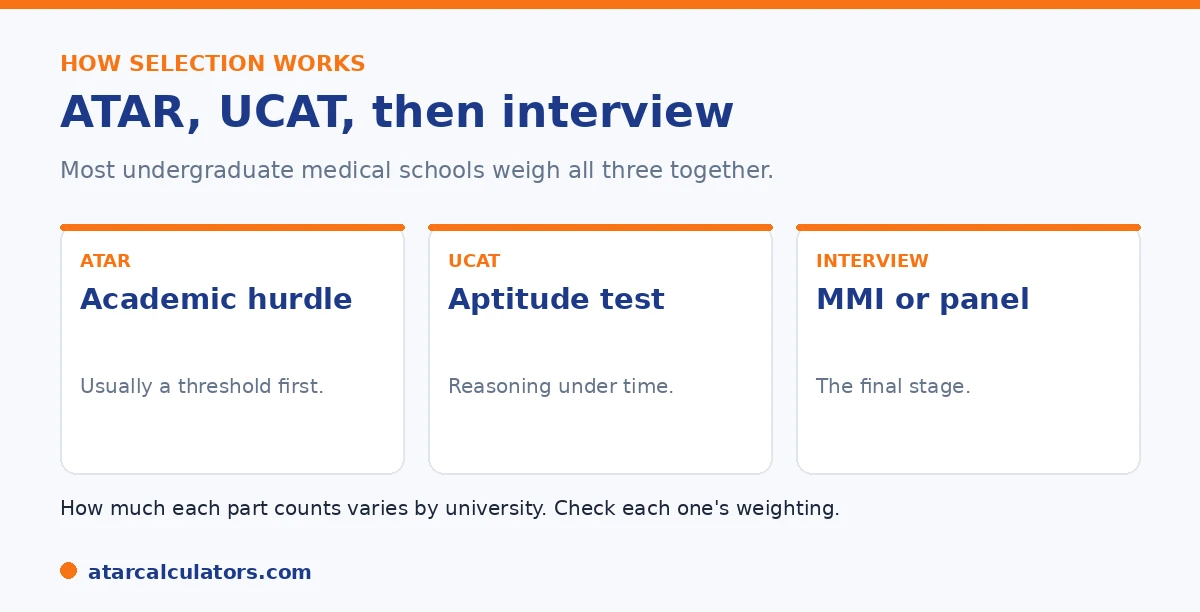
Here is the short version. Most undergraduate medical schools use three things together: your ATAR, your UCAT score, and an interview. The ATAR is often a hurdle you must clear to be considered. The UCAT, an aptitude test sat in Year 12, helps rank applicants. Shortlisted students are then interviewed. How much each part counts varies by university, so neither the ATAR nor the UCAT is universally more important.
Students often ask whether the UCAT or the ATAR matters more for medicine. The answer is that both matter, and how they combine depends on the university.
Below is how the two work together. To explore your options, use our medicine ATAR calculator.
Key takeaways
- Medicine uses your ATAR, your UCAT, and an interview.
- The ATAR is often a hurdle to be considered.
- The UCAT is an aptitude test sat in Year 12.
- Shortlisted students are then interviewed.
- How much each part counts varies by university.
- Neither is universally more important than the other.
Three parts, weighed together
Most undergraduate medical schools select on three things: your ATAR, your UCAT score, and an interview. They are not separate hoops; they are combined to rank and select applicants.
So a strong result in one area can help, but you cannot ignore the others. A brilliant ATAR with a weak UCAT, or the reverse, can still miss out.
The role of the ATAR
The ATAR is usually the academic gate. Many universities set an ATAR threshold you must clear to be considered for interview. At some, the ATAR also feeds into the final ranking, alongside the UCAT.
So a high ATAR is necessary, but at many universities, clearing the threshold is what matters most, after which the UCAT and interview take over. For the cut-offs, see our medicine ATAR guide.
The role of the UCAT
The UCAT is an aptitude test, sat in Year 12, that measures reasoning rather than curriculum knowledge. It is used to rank applicants, often heavily, once the ATAR hurdle is cleared.
There is no fixed UCAT score you need, because it works as a ranking against other applicants each year. A strong UCAT can make you very competitive, so it is worth serious preparation.
Because it is a ranking, the UCAT rewards preparation more than students expect. It is not a knowledge test you can cram the night before; it measures how quickly and accurately you reason under time pressure, across sections such as verbal reasoning, decision making, quantitative reasoning, and situational judgement. Those are skills, and skills improve with practice, so a student who works through timed practice over weeks typically ranks well above one who walks in cold with the same natural ability. The most common error is treating it as an afterthought behind the ATAR: at many medical schools the UCAT carries as much weight as your ATAR once you have cleared the threshold, so neglecting it can cost you the place even with a near-perfect ATAR. The practical takeaway is to give the UCAT real, scheduled preparation time through the first half of Year 12, learn the question types and the on-screen tools early, then build up to full timed sections so the pace of the real test feels familiar. For how to fit that around your exams, see our medicine strategy guide.
Want to see your medicine options?
Try the medicine ATAR calculator →The interview
The final stage is the interview, usually a multiple mini interview, or MMI, or a panel. Shortlisted applicants, chosen on ATAR and UCAT, are invited. The interview tests communication, ethical reasoning, and suitability for medicine.
It can carry significant weight in the final decision, so it is not a formality. Practising for the MMI format, including ethical scenarios, makes a real difference.
The weighting varies by university
The most important thing to know is that the weighting differs by university. Some lean more on the UCAT, some more on the interview, some keep the ATAR in the final ranking. There is no single formula.
So the answer to whether the UCAT or ATAR matters more is: it depends on the university. Check each one's selection model, and prepare for all three. See our medicine strategy guide.
Common questions
How do the UCAT and ATAR combine for medicine?
Most undergraduate medical schools use both, plus an interview. The ATAR is often a hurdle to be considered, the UCAT helps rank applicants, and shortlisted students are interviewed. How much each part counts varies by university.
What UCAT score do you need?
There is no fixed score, because the UCAT works as a ranking against other applicants each year. A strong score makes you more competitive, especially once you have cleared the ATAR threshold. Aim as high as you can.
Is the UCAT or ATAR more important?
Neither universally. It depends on the university's selection model. Some lean more on the UCAT, some on the interview, and some keep the ATAR in the final ranking. Prepare for all three rather than betting on one.
Does a high ATAR make up for a low UCAT?
Not always. At many universities the ATAR is a hurdle, after which the UCAT and interview take over, so a weak UCAT can still hold you back. The combination matters, and the weighting varies by university.
When do you sit the UCAT?
The UCAT is sat in Year 12, in the months before you apply, with results used in that year's admissions cycle. Plan your preparation around the test date, alongside your school studies.
Explore your medicine options
See realistic pathways into medicine based on your ATAR. Free, and no signup.
Open the medicine ATAR calculator →Related guides
This guide is general information for students and parents, not formal admissions advice. ATAR cut-offs, UCAT and GAMSAT requirements, interview formats and pathways vary by university and change every year. For graduate entry, applications run through GEMSAS, and the UCAT and GAMSAT are run by their own bodies. Any figures here are approximate and based on recent years, so always confirm the current details with each university and your state admissions centre (such as UAC, VTAC, QTAC, SATAC or TISC). Reviewed by the ATARCalculators Editorial Team.