Here is the short version. You can make a rough ATAR estimate in Year 11, but only a rough one. With two years still to go, your marks, subjects, and study habits can all change a lot, so an early prediction is a wide range rather than a precise number. It is useful for setting direction and planning, but not for fixing expectations. Treat a Year 11 estimate gently.
Year 11 students often want to know where they are heading, which is sensible. The honest answer is that you can get a direction, but not a precise number.
Below is what a Year 11 prediction can and cannot do. To try one, use our ATAR predictor.
Key takeaways
- You can make a rough estimate, but only rough.
- With two years to go, a lot can change.
- An early prediction is a wide range, not a number.
- It is useful for direction, not expectations.
- Your habits and subjects can still shift.
- Treat a Year 11 estimate gently.
Can you predict it this early?
You can produce an estimate in Year 11, using your current marks. But it is important to be honest about how rough it is. Two full years of study, assessments, and final exams still lie ahead.
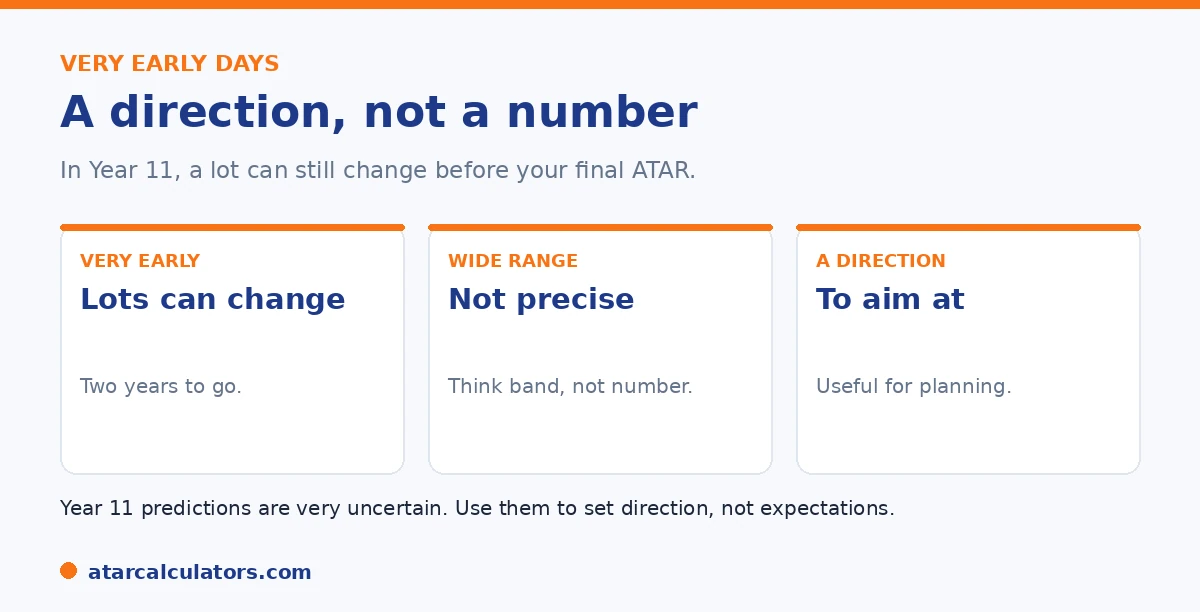
So a Year 11 prediction is best read as a wide range, not a single number. It points you in a direction rather than telling you a result.
How much can change
A great deal can change between Year 11 and your final ATAR. Your marks can rise as your study matures. Your subject mix may change. Scaling, which adjusts subject results, is unknown this far out.
Many students improve significantly in Year 12, once the stakes are clear and their skills develop. So an early estimate often understates what is possible with focused effort. See our guide on improving your predicted ATAR.
It helps to see just how many moving parts still sit between a Year 11 estimate and your final ATAR, because that is what makes an early number so loose. Your marks themselves are the least settled thing: study skills, exam technique and subject understanding often develop sharply in Year 12 as the work gets more serious, so a student tracking at one level in Year 11 can be at quite another by their finals. Your subject mix may still change, and dropping a weaker subject or adding one you are stronger in shifts the picture. Scaling, which adjusts every subject's results relative to its cohort, is simply unknown this far out and will not be known until results are finalised. And your ranking within each subject, which is what the ATAR ultimately reflects, can move as you and your cohort progress. Because all of these are still in flux, a Year 11 prediction is best treated as a rough orientation, not a ceiling or a promise. Its real value is motivational and directional: it shows roughly where you stand now and, run again with a more ambitious set of marks, how much a focused Year 12 could add. Use it to aim and to plan, not to define what you are capable of.
Why an early estimate is still useful
Despite the uncertainty, a Year 11 estimate has real value. It helps you see roughly where you stand, identify which subjects to focus on, and start thinking about realistic university directions.
Used this way, it supports planning rather than prediction. It is a starting point for setting goals, not a forecast of your result. See our guide on a target ATAR strategy.
Want a rough early estimate?
Try the ATAR predictor →The right mindset
The healthiest way to treat a Year 11 estimate is as encouragement to act, not a label. A lower estimate is not a ceiling, and a higher one is not a guarantee. Both can change with how you work over the next two years.
So use it to motivate and direct your effort, then focus on the work in front of you. The number will take care of itself as your real results come in. See our guide on predictor accuracy.
Common questions
Can you predict your ATAR in Year 11?
Only roughly. You can make an estimate from your current marks, but with two years still to go, a lot can change. So a Year 11 prediction is a wide range rather than a precise number, useful for direction not expectations.
How accurate is an early ATAR prediction?
Not very. With two full years of study, assessments, and final exams ahead, plus unknown scaling, an early estimate is broad. Many students improve significantly in Year 12, so it often understates what is possible.
Is a Year 11 ATAR estimate useful at all?
Yes, for planning. It helps you see roughly where you stand, choose which subjects to focus on, and think about realistic university directions. It supports goal-setting, rather than forecasting your final result.
Can my ATAR change a lot after Year 11?
Yes. Your marks can rise as your study matures, your subject mix may change, and scaling is unknown this far out. Many students improve in Year 12 once the stakes are clear and their skills develop.
Should I worry about a low Year 11 estimate?
No. An early estimate is not a ceiling. It reflects where you are now, not where you can get to with two years of focused effort. Use it to direct your work, not to limit your expectations.
Try an early estimate
See an indicative ATAR based on your current marks. Free, and no signup.
Open the ATAR predictor →Related guides
This guide is general information for students, not formal academic advice. A predicted ATAR is an estimate, not a guarantee. Your real ATAR is calculated from your official examinations and the scaling applied each year. Predictions are less reliable the earlier you make them. Confirm how the ATAR works for your state with your admissions centre, such as UAC, VTAC, QTAC, SATAC or TISC. Reviewed by the ATARCalculators Editorial Team.