
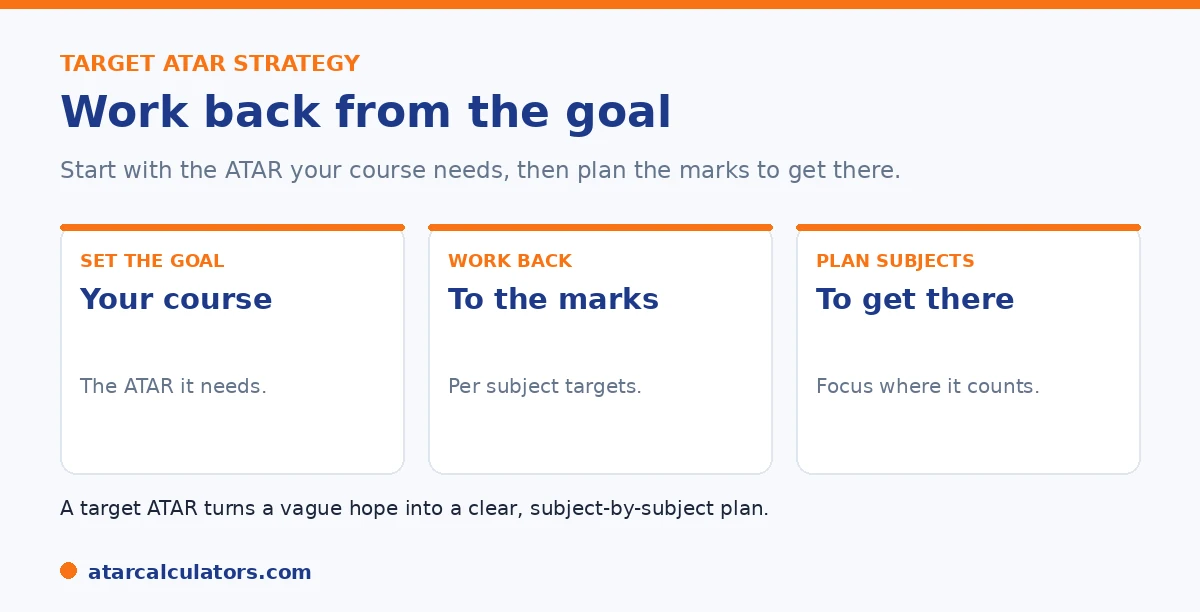
Here is the short version. A target ATAR strategy works backwards from your goal. Start with the ATAR your chosen course needs, including any adjustment factors, then translate that into the marks you need across your subjects, and build a study plan around it. This turns a vague hope into a clear, subject-by-subject target. Review and adjust it as real results come in.
Most students plan forwards: study hard and see what ATAR results. Working backwards from a goal is far more focused, because it tells you exactly what to aim for.
Below is how to build a target ATAR strategy. To see where you stand, use our ATAR predictor.
Key takeaways
- Start with the ATAR your course needs.
- Include any adjustment factors you expect.
- Translate it into marks per subject.
- Build a study plan around those targets.
- Review and adjust as results come in.
- A target turns a hope into a clear plan.
1. Start with the course
Begin at the end: the course you want, and the ATAR it needs. Look up its recent selection rank, remembering that this is usually a selection rank, not a raw ATAR, and that it changes each year.
If you are considering several courses, use the highest target as your goal, so you keep your options open. That number becomes the anchor for everything else. See our selection rank calculator.
2. Factor in adjustments
Next, account for any adjustment factors you expect, such as subject or location adjustments. These lift your selection rank above your raw ATAR, so they affect the ATAR you actually need.
If you expect a few points of adjustments, your raw ATAR target can be a little lower than the course cut-off. Be conservative here, since adjustments vary. See our guide on selection rank.
3. Work back to the marks
Now translate your target ATAR into the marks you need across your subjects. A predictor helps here: you can test what combinations of marks would reach your target, given how your subjects scale.
This gives you a concrete number to aim for in each subject, rather than a vague sense of working hard. It makes the goal real and measurable. See our guide on predictor accuracy.
Working backwards from a target ATAR to per-subject marks is what turns an abstract goal into a plan you can act on, and a few principles make it realistic. Because scaling differs by subject, there is no single set of marks for a given ATAR; a strongly scaled subject reaches the same contribution at a lower raw mark than a weakly scaled one. So the useful exercise is to test combinations: use a predictor to see what marks across your actual subjects would reach your target, then choose a combination that plays to your strengths rather than assuming uniform marks everywhere. It usually makes sense to aim a little higher in subjects you are already strong in, since lifting a subject you are good at is generally easier than rescuing a weak one, and to lean on your strongly scaled subjects where a given mark counts for more. Build in a margin, too: set your per-subject targets slightly above what the ATAR strictly needs, so a weaker exam in one subject does not sink the whole goal. And treat the targets as live, not fixed, because as your trial and assessment marks come in you will see which subjects are ahead and which need attention, and can redirect effort accordingly. Done this way, your target ATAR becomes a set of concrete, subject-by-subject marks you can track and adjust, which is far more motivating and useful than simply resolving to work hard.
Want to test what marks reach your target?
Try the ATAR predictor →4. Build the study plan
With per-subject targets set, build a study plan to hit them. Give the most time to the subjects where you are furthest from your target, and the ones that scale most strongly toward your goal.
This focuses your effort where it matters most, rather than spreading it evenly regardless of need. See our guide on improving your predicted ATAR.
5. Review and adjust
Finally, treat your strategy as a living plan. As real assessment results come in, compare them with your targets and adjust. Some subjects may need more focus, others less.
This keeps your plan realistic and responsive, rather than a fixed guess made at the start of the year. A target ATAR strategy works best when you revisit it regularly.
Common questions
How do I work backwards from a target ATAR?
Start with the ATAR your chosen course needs, account for any adjustment factors you expect, translate that into the marks you need per subject, then build a study plan around those targets and review it as results come in.
What marks do I need for my goal ATAR?
It depends on your subjects and how they scale. A predictor lets you test which combinations of marks would reach your target, giving you a concrete number to aim for in each subject rather than a vague goal.
Should I plan for the course cut-off or higher?
Aim a little above the recent cut-off where you can, since cut-offs change each year and are usually selection ranks, not raw ATARs. If you are considering several courses, plan for the highest target to keep options open.
How do adjustment factors affect my target?
They lift your selection rank above your raw ATAR, so if you expect a few points of adjustments, your raw ATAR target can be a little lower than the cut-off. Be conservative, since adjustments vary by university.
How often should I review my target ATAR plan?
Regularly, as real assessment results come in. Compare them with your targets and adjust which subjects need more focus. A target ATAR strategy works best as a living plan, not a fixed guess made at the start.
Plan toward your target
See where you stand and what marks reach your goal. Free, and no signup.
Open the ATAR predictor →Related guides
This guide is general information for students, not formal academic advice. A predicted ATAR is an estimate, not a guarantee. Your real ATAR is calculated from your official examinations and the scaling applied each year. Predictions are less reliable the earlier you make them. Confirm how the ATAR works for your state with your admissions centre, such as UAC, VTAC, QTAC, SATAC or TISC. Reviewed by the ATARCalculators Editorial Team.