Here is the short version. A mock exam ATAR is a snapshot of where you stand today, not your final result. There is still time to improve before the real exams, and mock marks are not scaled. The most valuable thing a mock gives you is a clear picture of which topics and skills to work on next. So read it as a guide for action, not a prediction of your outcome.
Mock exams can be sobering or encouraging, and either way the score grabs your attention. The trick is to use it as information, not a judgement.
Below is how to interpret a mock ATAR. To estimate from your marks, use our ATAR predictor.
Key takeaways
- A mock ATAR is a snapshot, not your final result.
- There is still time to improve before the real exams.
- Mock marks are not scaled.
- Its real value is showing what to work on.
- Read it as a guide for action, not a prediction.
- A low mock is a starting point, not a ceiling.
A mock ATAR is a snapshot
A mock exam ATAR shows where you stand at one moment, based on one set of papers. It is a snapshot, not a forecast. Your final result depends on how you perform later, after more preparation.
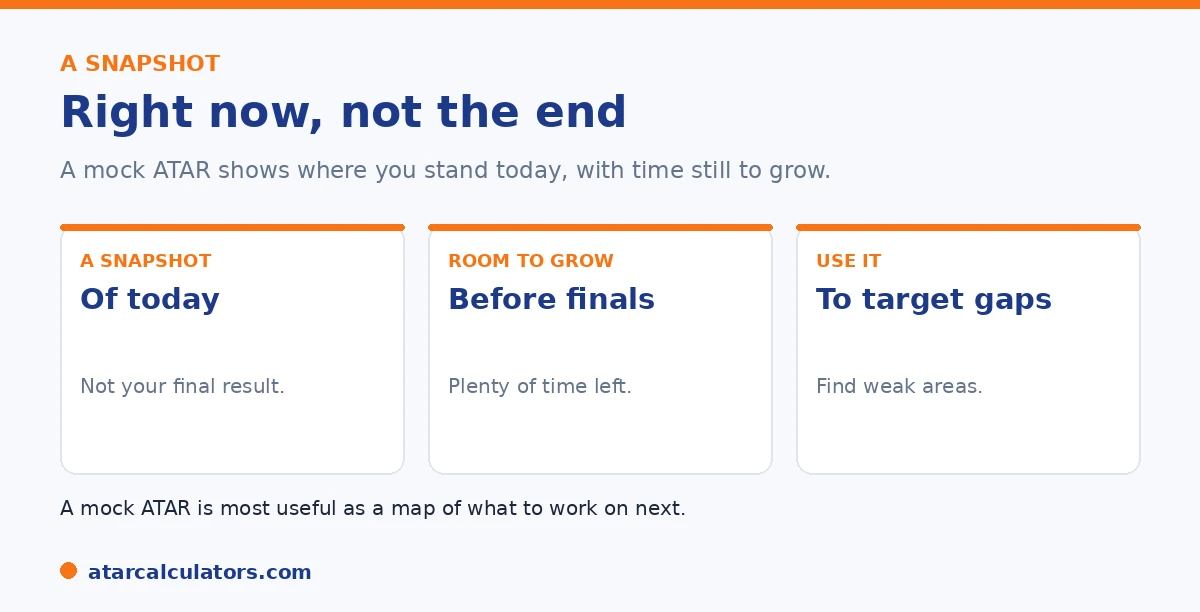
So a mock score tells you about today, not necessarily about exam day. Treat it as a checkpoint, not a conclusion.
There is room to grow
Between a mock and the real exams, there is genuine time to improve. Many students lift their results in that window, especially when the mock highlights clear, fixable gaps.
Also remember that mock marks are not scaled, so they are not the same as a final, scaled result. A mock is an estimate built on raw marks. See our guide on predictor accuracy.
Two things make the gap between a mock and your final result larger than students expect, and both work in your favour if you use them well. First, timing: a mock sits before your last stretch of concentrated revision, so it captures where you are, not where you will be. Students who respond to a disappointing mock with focused work routinely finish well above it, because there is real, usable time between the two. Second, marking: mocks are often graded strictly to prepare you for the real thing, and they run on raw marks rather than the scaled marks that actually build your ATAR, so the headline number tends to understate your eventual position. Put together, a mock is best read as a conservative snapshot and a diagnostic, not a prediction. The productive response is to treat a weaker-than-hoped mock as information rather than a verdict: identify the specific topics and question types that cost you marks, rebuild your revision around them, and keep sitting timed practice so the improvements hold under exam conditions. A mock that exposes a fixable gap while there is still time to fix it has done exactly its job, and the students who take it that way are the ones who climb.
Want to estimate your ATAR?
Try the ATAR predictor →Use it to target your gaps
The most valuable part of a mock is not the number, but the detail behind it. Look at which questions and topics cost you marks, and why. That tells you exactly where to focus next.
So treat a mock as a diagnostic tool. Build your revision around the specific gaps it reveals, while there is still time to close them. See our guide on improving your predicted ATAR.
Keep perspective
Finally, keep a low mock score in perspective. It reflects where you are now, not where you can get to. Used well, a disappointing mock can be the wake-up call that lifts your final result.
And a strong mock is encouraging, but not a guarantee, so keep working. Either way, the mock is a tool to guide your effort, not a label to carry.
Common questions
How do I interpret a mock exam ATAR?
Read it as a snapshot of where you stand today, not your final result. There is still time to improve, and mock marks are not scaled. Its real value is showing which topics and skills to work on next.
Are mock exams accurate for ATAR?
They give a rough guide, but they are not the final word. Mock marks are not scaled and reflect one moment in your preparation. Use the mock to spot gaps, rather than as a precise prediction of your ATAR.
What does a mock ATAR tell me?
Mainly where you stand right now, and where your gaps are. The detail behind the score, which topics and skills cost you marks, is more useful than the number itself for guiding your revision.
Can I improve after a low mock ATAR?
Yes. A mock reflects where you are now, not where you can get to. Many students lift their results between a mock and the real exams, especially when the mock highlights clear, fixable gaps.
Are mock marks scaled like the real ATAR?
No. Mock marks are raw and unscaled, so a mock ATAR is an estimate, not a final scaled result. Scaling is applied only when your real ATAR is calculated, based on the whole cohort.
Estimate your ATAR
See an indicative ATAR based on your marks. Free, and no signup.
Open the ATAR predictor →Related guides
This guide is general information for students, not formal academic advice. A predicted ATAR is an estimate, not a guarantee. Your real ATAR is calculated from your official examinations and the scaling applied each year. Predictions are less reliable the earlier you make them. Confirm how the ATAR works for your state with your admissions centre, such as UAC, VTAC, QTAC, SATAC or TISC. Reviewed by the ATARCalculators Editorial Team.