
Here is the short version. There is real room to lift your ATAR before final exams. The most effective moves are to focus your weakest subjects, where the gains are largest, to push your strongly scaled subjects, to stay consistent across all your subjects, to sharpen your exam technique, and to protect your sleep and wellbeing so you perform on the day. Steady, targeted effort beats last-minute cramming.
Many students treat their predicted ATAR as fixed, but it is not. Marks often move between now and the finals, and the direction is largely up to you.
Below are five practical ways to improve it. To see where you stand, use our ATAR predictor.
Key takeaways
- Focus your weakest subjects, where gains are largest.
- Push your strongly scaled subjects.
- Stay consistent across all your subjects.
- Sharpen your exam technique.
- Protect your sleep and wellbeing.
- Steady effort beats last-minute cramming.
1. Focus your weakest subjects
The biggest gains usually come from your weakest subjects, because that is where you have the most room to improve. Lifting a low mark by ten points does more for your ATAR than nudging an already strong one.
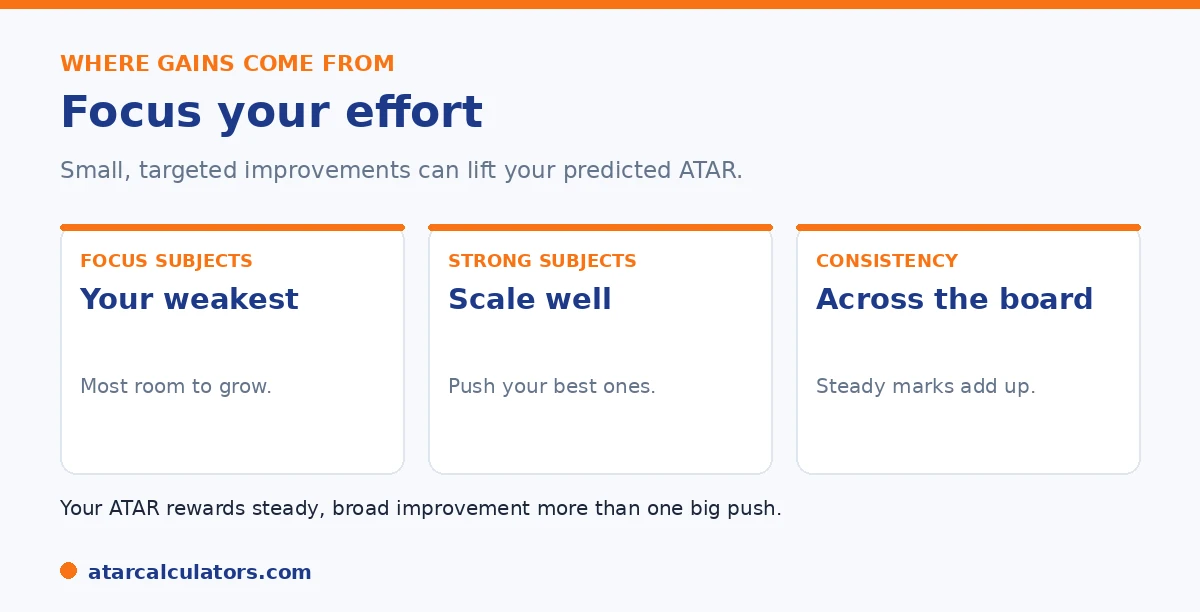
So look at where you are losing the most marks, and target that first. It can feel uncomfortable to work on weaker areas, but that is exactly where the return is highest.
2. Push your strongly scaled subjects
Some subjects scale more strongly than others, meaning strong results in them count for more toward your ATAR. If you are already doing well in a strongly scaled subject, pushing it further can be very efficient.
This does not mean chasing scaling at the expense of subjects you enjoy or need. But where you have a strongly scaled subject within reach, it is worth the effort. See our ATAR calculators.
The key is to understand what scaling actually rewards, so you push in the right place rather than the wrong one. Scaling reflects the strength of the cohort in a subject, so subjects taken by academically strong students, higher-level mathematics and the sciences among them, tend to scale up, meaning a given level of performance converts into more toward your ATAR. The efficient move is not to switch into a high-scaling subject you will struggle in, since a modest mark in a strongly scaled subject can be worth less than a strong mark in a moderately scaled one. It is to lift the subjects you already take that both scale well and sit within your reach. If you are tracking a solid but not top mark in a strongly scaled subject, extra effort there compounds: the improvement in your raw mark is amplified by the favourable scaling. Contrast that with a subject that scales down, where the same lift in raw marks translates into a smaller gain. So audit your current subjects, identify which ones scale strongly, and among those pick the one or two where you have the most room to improve. That is where focused work moves your ATAR furthest, without abandoning subjects you need for prerequisites or genuinely perform well in.
3. Stay consistent across subjects
Your ATAR draws on several subjects, so consistency matters. A single brilliant result cannot carry a set of weak ones. Steady, solid marks across the board usually beat a spiky profile.
So resist the urge to pour everything into one subject. Spread your effort to keep every subject ticking along, while still targeting your weakest. See our guide on predictor accuracy.
Want to see how changes affect your ATAR?
Try the ATAR predictor →4. Sharpen your exam technique
Marks are often lost not from gaps in knowledge, but from exam technique: misreading questions, poor time management, or weak structure. These are fixable, and quickly.
Practise under timed conditions with past papers, and review where you lose marks. Polishing technique can lift results across every subject at once, without learning a single new fact.
5. Protect your sleep and wellbeing
Finally, do not overlook the basics. Sleep, breaks, and managing stress directly affect how you perform on exam day. Burning out in the final weeks can undo months of work.
So build rest into your plan, not as a reward but as part of the strategy. A calm, well-rested mind recalls more and thinks more clearly under pressure. Steady effort with good wellbeing beats frantic cramming.
Common questions
How can I improve my predicted ATAR before finals?
Focus your weakest subjects, where gains are largest, push your strongly scaled subjects, stay consistent across all subjects, sharpen your exam technique, and protect your sleep and wellbeing so you perform on the day.
How much can your ATAR rise after trials?
It varies, but meaningful improvement is common. Many students lift their marks between trials and finals with focused revision, especially in their weakest subjects, where there is the most room to gain.
Which subjects should I focus on to lift my ATAR?
Usually your weakest, since that is where you have the most room to improve, and any strongly scaled subjects within reach. Lifting a low mark tends to help more than nudging an already strong one.
Does exam technique really affect my ATAR?
Yes. Marks are often lost to misreading questions, poor time management, or weak structure, not gaps in knowledge. Practising under timed conditions and fixing these can lift results across every subject.
Is cramming a good way to raise my ATAR?
No. Steady, targeted effort with good sleep and wellbeing beats last-minute cramming. Burning out in the final weeks can undo months of work, while a calm, rested mind performs better on the day.
See where you stand
Estimate your ATAR and see how improvements could help. Free, and no signup.
Open the ATAR predictor →Related guides
This guide is general information for students, not formal academic advice. A predicted ATAR is an estimate, not a guarantee. Your real ATAR is calculated from your official examinations and the scaling applied each year. Predictions are less reliable the earlier you make them. Confirm how the ATAR works for your state with your admissions centre, such as UAC, VTAC, QTAC, SATAC or TISC. Reviewed by the ATARCalculators Editorial Team.