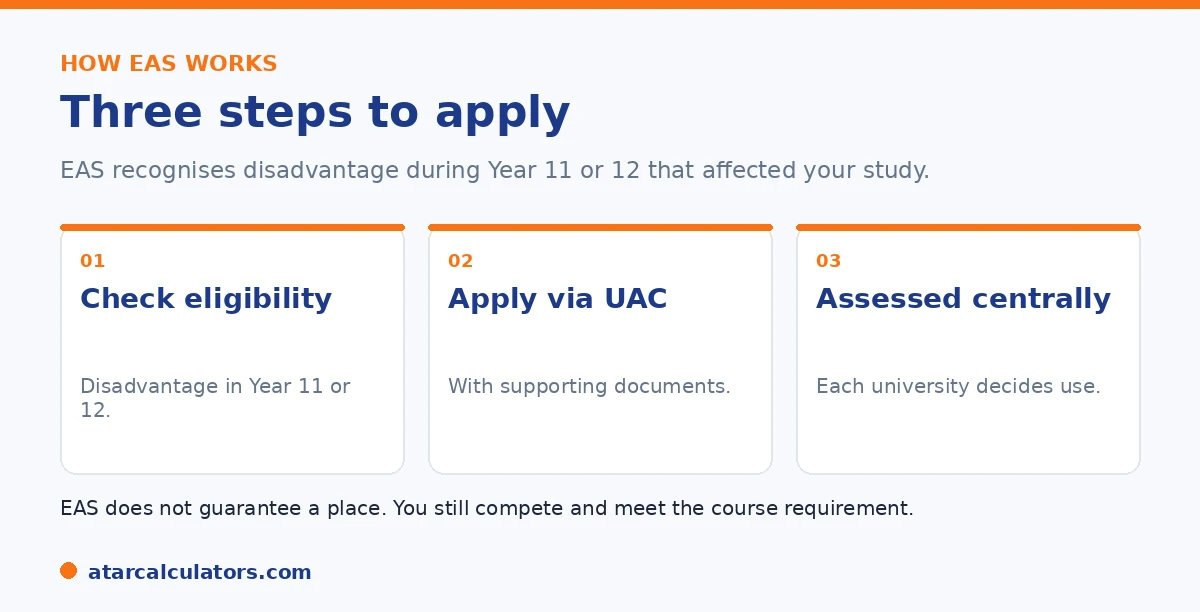
Here is the short version. The Educational Access Scheme, or EAS, is for students whose study was affected by hardship during Year 11 or 12. You apply once through your admissions centre, with supporting documents. It is assessed centrally, and each university decides how to use it, either by lifting your selection rank or holding a reserved place. EAS does not guarantee entry, and some universities set a minimum ATAR before they consider it.
EAS is one of the most valuable schemes, yet many eligible students never apply, often because they are not sure they qualify. The criteria are broader than people expect.
Below is who can apply, and how. To estimate your selection rank with adjustments, use our bonus points calculator.
Key takeaways
- EAS is for educational disadvantage during Year 11 or 12.
- You apply once through your admissions centre.
- You need supporting documents for your circumstances.
- It can lift your selection rank or give a reserved place.
- It does not guarantee entry; you still compete.
- Some universities set a minimum ATAR before considering it.
What the Educational Access Scheme is
The Educational Access Scheme, or EAS, recognises that hardship can affect your results. It is for students whose study was disrupted by difficult circumstances during Year 11 or 12.
The aim is fairness. If your circumstances held your results back, EAS gives universities a way to take that into account.
Who is eligible
The categories are broad. They include financial hardship, an illness or disability, a difficult home environment, English language difficulty, disrupted schooling, refugee status, and attending an under-resourced school, among others.
The key test is that your circumstances affected your study during Year 11 or 12. If that sounds like you, it is worth applying, even if you are unsure. The assessment will decide.
How to apply
You apply once, through your state admissions centre, alongside your university application. In NSW and the ACT this is UAC. You complete one EAS application that covers all participating universities.
You will need supporting documents for your circumstances, such as an educational impact statement, and sometimes a medical impact statement. Your school can usually help. Apply by the deadline, which is often well before offers.
Want to estimate your selection rank?
Try the bonus points calculator →How EAS is used
EAS is assessed centrally, using the same guidelines for everyone. But each university decides how to use the result. Some add points to your selection rank. Others hold several reserved places for EAS students.
Unlike subject and location adjustments, you are usually not told exactly how many points EAS adds, since it works differently across universities and courses. Some universities publish their approach; many do not.
Important limits to know
Two things are worth knowing. First, EAS does not guarantee a place. You still need to meet the course requirement and compete with other applicants. It improves your position; it is not an automatic offer.
Second, some universities set a minimum ATAR before they will consider EAS, and some do not offer it for certain courses, such as competitive ones. So check each university and course. See our bonus points guide.
Understanding these limits keeps your expectations realistic and helps you use EAS where it actually works. The scheme lifts your selection rank, which improves your position against a cut-off, but it does not override the other requirements of a course: you still need any prerequisite subjects, and for courses with extra selection steps like interviews, auditions or portfolios, EAS points do not replace them. Some universities also apply a floor, meaning your ATAR must reach a certain level before EAS points are added, so a very low ATAR may not be rescued by the scheme alone. And several the most competitive courses, or specific programs, either cap or exclude EAS adjustments, which is why the value of the scheme varies from course to course. None of this makes EAS less worth pursuing; it simply means you should treat it as a genuine boost within a system that still has other rules, rather than a guaranteed path in. The practical approach is to apply for EAS if you qualify, since the points are real and often decisive in the middle of the range, but to check, for each course you want, whether it applies EAS, whether there is a minimum ATAR, and whether any prerequisites or extra selection steps still apply. Used with that awareness, EAS is one of the strongest tools available to students whose results were affected by disadvantage.
Common questions
How do I apply for EAS bonus points?
You apply once through your state admissions centre, such as UAC in NSW and the ACT, alongside your university application. You provide supporting documents for your circumstances, and apply by the deadline, which is often well before offers.
Am I eligible for the Educational Access Scheme?
You may be if hardship affected your study during Year 11 or 12. Categories include financial hardship, illness or disability, a difficult home environment, disrupted schooling, and refugee status, among others. The assessment decides eligibility.
What documents does EAS need?
Supporting documents for your circumstances, such as an educational impact statement, and sometimes a medical impact statement. Your school can usually help you prepare these. Requirements depend on the categories you apply under.
How many points does EAS give?
It varies, and you are usually not told an exact number. EAS is assessed centrally, but each university decides how to use it, either by lifting your selection rank or holding reserved places. Some publish their approach; many do not.
Does EAS guarantee me a place?
No. EAS does not guarantee entry. You still need to meet the course requirement and compete with other applicants. It can improve your position, but it is not an automatic offer.
Do all universities accept EAS for all courses?
No. Some universities set a minimum ATAR before considering EAS, and some do not offer it for certain courses, such as highly competitive ones. Check each university and course directly.
Estimate your selection rank
See how adjustments could change your selection rank. Free, and no signup.
Open the bonus points calculator →Related guides
This guide is general information for students and parents, not formal admissions advice. Adjustment factors, schemes, caps and course cut-offs are set by each university and can change every year. They differ from one institution to another, and from course to course within the same institution. Always confirm the current details with the specific university and your state admissions centre (UAC, VTAC, QTAC, SATAC or TISC). A useful starting point is UAC's guide to selection rank adjustments. Reviewed by the ATARCalculators Editorial Team.