
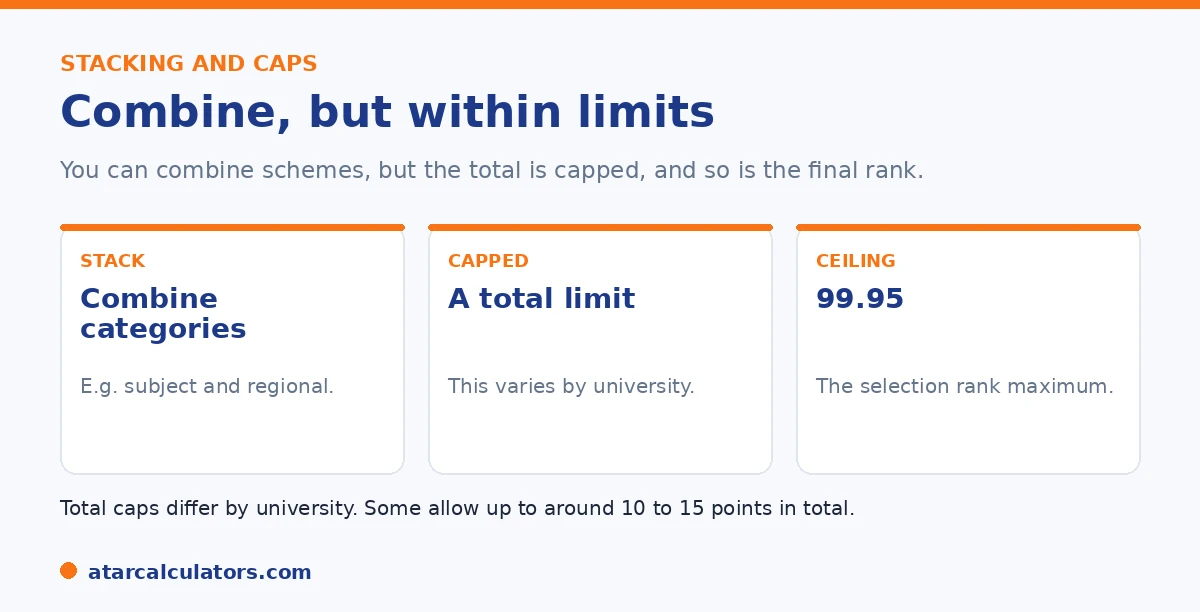
Here is the short version. You can stack adjustment factors across different categories, such as subject and location and equity. But there are limits. Each university caps the total it awards, often somewhere around 10 to 15 points, and within a single scheme the points may not all add up. On top of that, your selection rank cannot go above 99.95. So there is no single universal maximum, since the cap varies by university.
It is natural to wonder how high bonus points can go. The honest answer is that it depends on the university, because each sets its own cap.
Below is how stacking works, and the limits. To estimate your total, use our bonus points calculator.
Key takeaways
- You can stack adjustments across different categories.
- Each university caps the total, often around 10 to 15 points.
- Within one scheme, points may not all add up.
- Your selection rank cannot exceed 99.95.
- There is no single universal maximum.
- The cap varies by university, so check each one.
How stacking works
Stacking means combining adjustments from different categories. For example, you might get subject adjustments and location adjustments and an equity adjustment, and these can add together toward your selection rank.
So a student who qualifies in several categories can build a meaningful boost. The limits, though, are where it gets specific.
The university total cap
The main limit is the university's total cap. Each university sets a maximum number of adjustment points it will award in total, no matter how many you qualify for. This is often somewhere around 10 to 15 points, but it varies.
So if you qualify for more than the cap, you get the cap. The exact figure is set by each university, so always check the specific one. There is no single national maximum.
Want to add up your bonus points?
Try the bonus points calculator →Limits within a single scheme
There is a second, smaller limit. Within a single scheme, points often do not all add up. A subject scheme, for instance, may give you the points for your best qualifying subject, not the sum of every one.
So studying several qualifying subjects does not always mean several lots of points. Check each scheme's rules, since this varies by university.
The 99.95 ceiling
Above all the scheme caps sits one hard ceiling. Your selection rank cannot exceed 99.95, the maximum possible ATAR. No amount of adjustments takes you past it.
So a student already near the top gains little from adjustments, while a student below a cut-off has the most to gain. For how the rank is built, see our selection rank guide.
The ceiling explains a pattern that surprises many students: bonus points are worth most exactly where students assume they matter least. Picture three students. One has an ATAR of 99: even a generous ten points of eligibility cannot lift their selection rank past 99.95, so barely a fraction of those points does anything. Another sits at 85 with a target course cut-off of 90; the same ten points takes them to 95, comfortably over the line, so every point is doing real work. A third has an ATAR of 70 chasing a course at 95; here the points help but cannot close a gap that large. The lesson is that adjustments are a mid-range lever. If you are near the top, focus your energy on the ATAR itself, since that is what still moves. If you are in the broad middle, treat bonus points seriously, because they can be the difference between courses. And if you are far below a target cut-off, use the points where they help but also widen your list to courses your adjusted rank can realistically reach. Reading the ceiling this way keeps expectations honest and directs effort to where it changes outcomes.
Common questions
What is the maximum bonus points possible?
There is no single universal maximum, because each university sets its own cap. The total is often somewhere around 10 to 15 points, but it varies. On top of that, your selection rank cannot exceed 99.95.
Can you stack bonus points?
Yes, across different categories. You might combine subject, location, and equity adjustments, and these can add toward your selection rank. But the total is capped by each university, and within a single scheme points may not all add up.
How many adjustment factors can you combine?
You can combine adjustments from different categories, up to the university's total cap, which is often around 10 to 15 points. The exact limit varies by university, so check the specific one you are applying to.
Is there a cap on bonus points?
Yes, two kinds. Each university caps the total it awards, and within a single scheme points may not all add up. On top of both, your selection rank cannot exceed 99.95, the maximum ATAR.
Do points within the same scheme add up?
Often not. Many schemes give you the points for your best qualifying result, not the sum of all of them. For example, a subject scheme may count your strongest subject only. Check each scheme's rules.
Add up your bonus points
See how many adjustment factors you might get and your likely selection rank. Free, and no signup.
Open the bonus points calculator →Related guides
This guide is general information for students and parents, not formal admissions advice. Adjustment factors, schemes, caps and course cut-offs are set by each university and can change every year. They differ from one institution to another, and from course to course within the same institution. Always confirm the current details with the specific university and your state admissions centre (UAC, VTAC, QTAC, SATAC or TISC). A useful starting point is UAC's guide to selection rank adjustments. Reviewed by the ATARCalculators Editorial Team.