Here is the short version. There is no official ATAR-to-GPA conversion table, because the two measure different things. Your ATAR is a rank showing your position among Year 12 students. A GPA is a grade average from your university results. They sit on different scales, at different stages. Any conversion table you find is approximate and unofficial, so treat it as a rough guide, never an exact equivalence.
Students often want a simple table that turns an ATAR into a GPA. It is a reasonable wish, but the tables you find online rest on shaky ground.
Below is why no official table exists, and what to do instead. For an indicative view, use our ATAR to GPA converter.
Key takeaways
- There is no official ATAR-to-GPA conversion table.
- ATAR is a rank; GPA is a grade average.
- They sit on different scales, at different stages.
- Any table you find is approximate and unofficial.
- Treat conversions as a rough guide only.
- For overseas use, ask the specific institution.
Why no official table exists
The reason is simple once you see it. Your ATAR is a rank, showing where you sat among Year 12 students. A GPA is an average of your university grades. They measure different things, at different stages of your education.
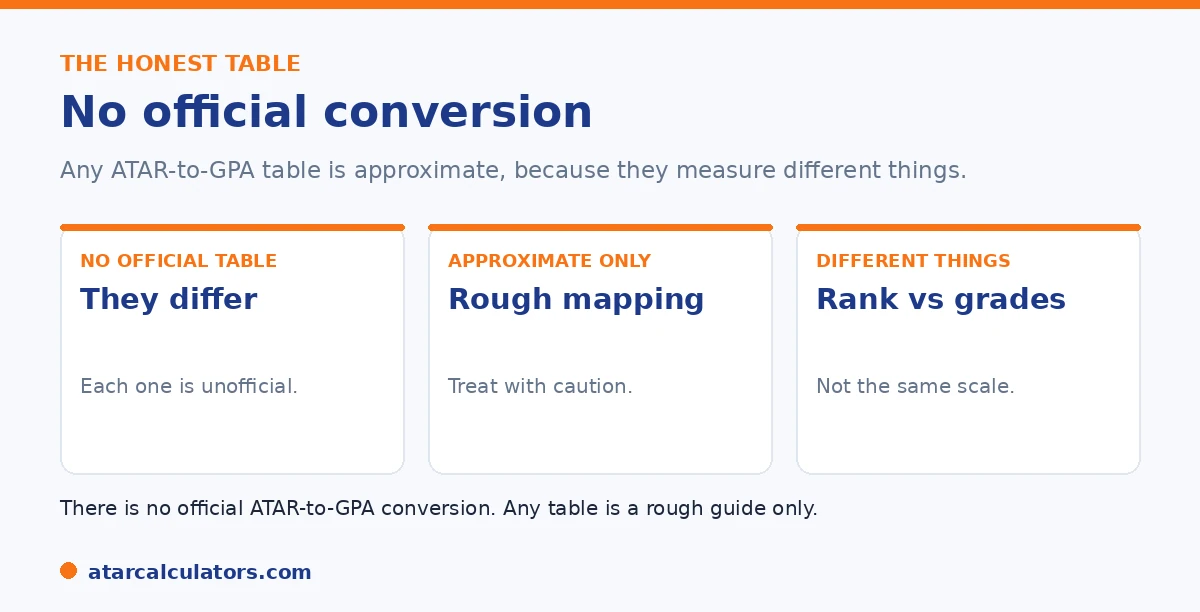
Because one is a school-leaving rank and the other a university grade average, there is no clean formula to turn one into the other. So no official body publishes a conversion.
What online tables really are
The tables you find online are approximations, often lining up an ATAR range with a GPA band by rough analogy. They can give a loose sense of scale, but they are not authoritative, and they vary from one source to another.
So if you see a table claiming an ATAR of 95 equals a particular GPA, treat it with caution. It is one source's estimate, not an official equivalence. See our guide on whether you can convert ATAR to GPA.
Want an indicative view?
Try the ATAR to GPA converter →What to do instead
If you actually need a GPA, the right approach depends on why. For most domestic purposes, you do not need to convert your ATAR at all, since universities use your university results, not your ATAR.
For overseas applications, ask the specific institution for its needed conversion, or use a credential evaluation service. They will tell you how they want your results presented. See our guide on ATAR vs GPA.
Breaking it down by situation removes most of the confusion. If you are a current or prospective Australian university student, you do not convert your ATAR into a GPA at all; your GPA is generated from your actual university marks once you have them, and any application asking for a GPA wants that figure, not a number derived from Year 12. If you are still at school and simply curious how your ATAR "translates", treat any conversion as a rough sense of scale only, useful for context but meaningless for applications, because the two measure different things at different stages. If you are applying overseas, where a GPA is the common currency, the correct move is to ask the getting institution or a recognised credential evaluation service exactly how they want your Australian results expressed; they apply their own methodology, and a homemade conversion will not be accepted. And if an Australian scholarship or program lists a GPA requirement, calculate it from your university transcript using that institution's grade scale, since a GPA is only meaningful against the scale that produced it. In short: use your real university GPA where one is needed, ask the assessing body how they want results presented for overseas cases, and never submit an ATAR-derived estimate as though it were a GPA.
Common questions
Is there an ATAR-to-GPA conversion table?
Not an official one. ATAR is a school-leaving rank and GPA is a university grade average, so they measure different things and cannot be cleanly converted. Any table online is approximate and unofficial.
What GPA is an ATAR of 95?
There is no official answer, because ATAR and GPA are different measures on different scales. Online tables that map an ATAR to a GPA are rough approximations from individual sources, not authoritative equivalences.
Do conversion tables differ between sources?
Yes, because none is official. Different sources line up ATAR ranges with GPA bands by rough analogy, so their figures vary. Treat any single table as one estimate, not a definitive conversion.
Do I need to convert my ATAR to a GPA?
Usually not, for domestic purposes, since universities use your university results, not your ATAR. For overseas applications, ask the specific institution for its needed conversion or use a credential evaluation service.
Why is there no official ATAR-to-GPA table?
Because your ATAR is a rank among Year 12 students, while a GPA is an average of university grades. They measure different things at different stages, so there is no clean formula and no official body publishes one.
See an indicative view
Explore how an ATAR loosely compares with a GPA scale. Indicative only.
Open the ATAR to GPA converter →Related guides
This guide is general information for students, not formal academic advice. ATAR and GPA measure different things on different scales, so there is no official conversion between them. Any figures here are approximate. For overseas applications, ask the specific institution for its needed conversion, or use a credential evaluation service. Grade scales also vary by university, so confirm with your own. The ATAR authority for your state is your admissions centre, such as UAC. Reviewed by the ATARCalculators Editorial Team.