Here is the short version. You cannot truly convert ATAR to GPA, because they are different measures on different scales. Your ATAR ranks you among Year 12 students; a GPA averages your university grades. There is no official conversion, and any figure is an approximation. If you need a GPA for an overseas application, ask the specific institution for its needed conversion, or use a credential evaluation service.
Plenty of tools claim to convert your ATAR to a GPA. The honest answer is that a true conversion is not really possible, and it helps to understand why.
Below is the honest answer, with what to do if you need a GPA. For an indicative view, use our ATAR to GPA converter.
Key takeaways
- You cannot truly convert ATAR to GPA.
- They are different measures on different scales.
- There is no official conversion.
- Any figure is an approximation.
- For overseas use, ask the institution.
- Domestically, you rarely need to convert at all.
The honest answer
The honest answer is no, not in any true sense. Your ATAR is a rank among Year 12 students. A GPA is an average of university grades. Converting one to the other is like converting your position in a race into your average lap time. They are simply different things.
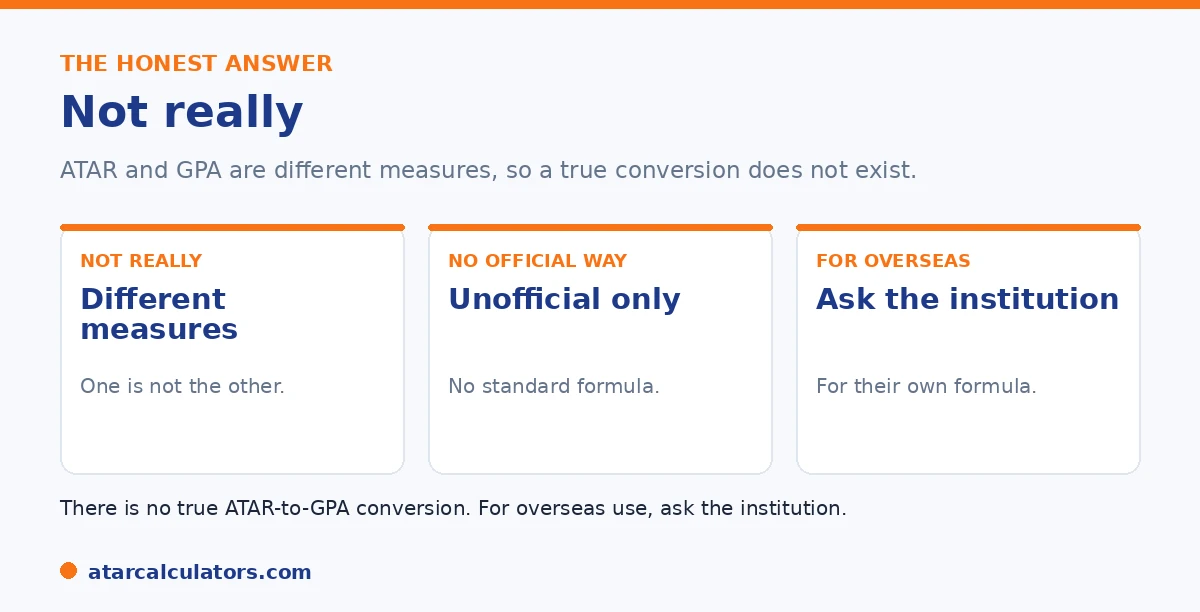
So while you can map an ATAR onto a GPA scale by rough analogy, that is an approximation, not a real conversion. No official body provides one.
Why a true conversion is not possible
Two things make it impossible. First, they measure different stages: school-leaving rank versus university performance. Second, a rank and a grade average are different kinds of number, so there is no formula linking them.
On top of that, GPA scales themselves vary, with 7.0 and 4.0 versions in use. So even the GPA side is not a single standard. See our guide on ATAR vs GPA.
It is worth unpacking why these obstacles are fundamental rather than just inconvenient, because it explains why any "ATAR to GPA" table you find online is guesswork. An ATAR is a rank: a 90 means you finished ahead of 90% of your Year 12 cohort, and it tells you nothing about your actual marks, only your position relative to everyone else. A GPA is an average of achievement: it takes your real university grades, converts each to grade points, and averages them against a fixed standard. Converting between a rank and an average is not a matter of finding the right formula; the two answer different questions, so there is no true mathematical bridge from one to the other. The timing gap compounds this, since your ATAR is fixed at the end of school while your GPA is built years later from work you have not yet done, so nothing about your university performance is determined by your rank at eighteen. And even the GPA end of the equation is not standardised: seven-point and four-point scales are both in use, and different institutions map marks to grade points differently, so the same transcript can yield more than one GPA. Put together, these are three independent reasons a genuine conversion cannot exist. The practical consequence is simple: never rely on an ATAR-to-GPA table for anything that matters, and where a GPA is genuinely needed, calculate it from real university marks on the relevant scale or ask the assessing body how they want your results expressed.
Want an indicative view?
Try the ATAR to GPA converter →What to do if you need a GPA
If you genuinely need a GPA, usually for an overseas application, the right step is to ask the specific institution how it wants your results presented. Many have their own equivalency approach, or use a credential evaluation service.
So rather than relying on a generic conversion, go to the source that needs the number. They will tell you the method they accept. See our guide on ATAR to GPA tables.
For domestic purposes
For most domestic purposes, you do not need to convert your ATAR at all. Australian universities use your ATAR for entry, then your university results, reported as a WAM or GPA, for everything afterward.
So your ATAR and your later university average serve different roles, and you rarely need to bridge them. See our guide on university grading.
Common questions
Can you convert ATAR to GPA?
Not truly. ATAR and GPA are different measures on different scales, so there is no real conversion between them. You can map an ATAR onto a GPA scale by rough analogy, but that is an approximation, not an official conversion.
Is there an official ATAR-to-GPA conversion?
No. No official body provides one, because your ATAR is a school-leaving rank and a GPA is a university grade average. They measure different things at different stages, so there is no standard formula linking them.
What GPA does my ATAR equal?
There is no exact answer, since the two are different measures. Any figure you see is an approximation from an individual source. For an official equivalence, you would need to ask the specific institution requesting it.
How do I get a GPA for an overseas application?
Ask the specific institution how it wants your results presented. Many have their own equivalency approach or use a credential evaluation service. Go to the source that needs the number rather than using a generic conversion.
Do I need to convert my ATAR for Australian universities?
Usually not. Australian universities use your ATAR for entry, then your university results, reported as a WAM or GPA, afterward. So your ATAR and your university average serve different roles and rarely need bridging.
See an indicative view
Explore how an ATAR loosely compares with a GPA scale. Indicative only.
Open the ATAR to GPA converter →Related guides
This guide is general information for students, not formal academic advice. ATAR and GPA measure different things on different scales, so there is no official conversion between them. Any figures here are approximate. For overseas applications, ask the specific institution for its needed conversion, or use a credential evaluation service. Grade scales also vary by university, so confirm with your own. The ATAR authority for your state is your admissions centre, such as UAC. Reviewed by the ATARCalculators Editorial Team.