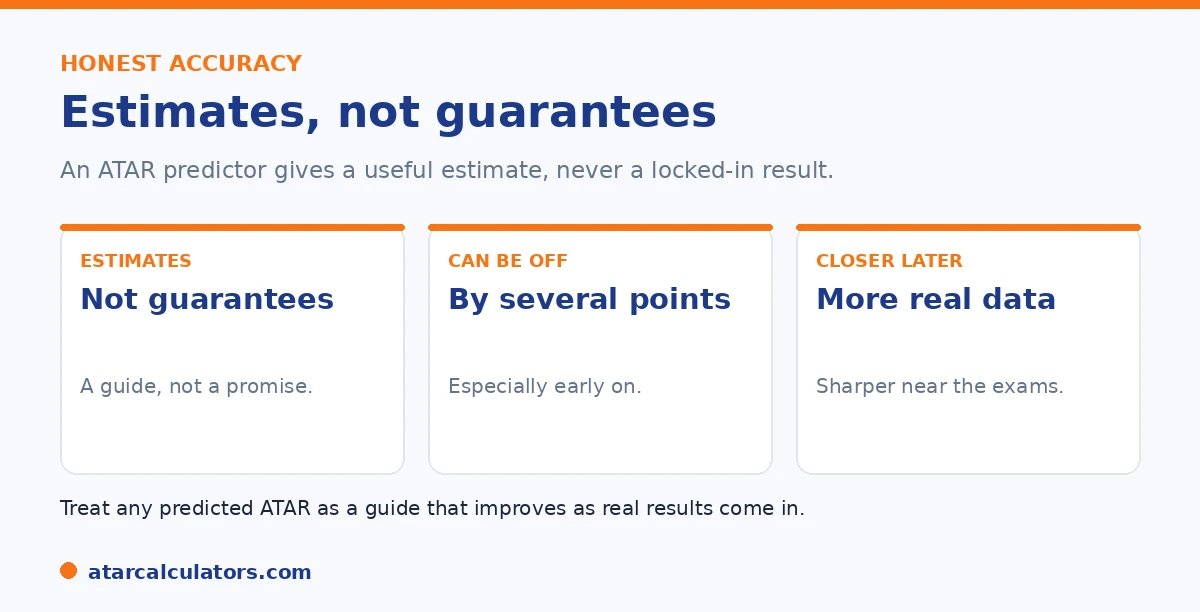
Here is the short version. An ATAR predictor gives a useful estimate, not a guarantee. It can be off by several points, especially early in your studies, because it relies on incomplete marks and cannot know the final scaling. Accuracy improves as you gather real results closer to your exams. So a predicted ATAR is best treated as a guide that sharpens over time, not a fixed result.
ATAR predictors are everywhere, and they can be reassuring or alarming. The key is understanding how much weight to put on the number they give you.
Below is an honest look at their accuracy. To try one, use our ATAR predictor.
Key takeaways
- A predictor gives a useful estimate, not a guarantee.
- It can be off by several points, especially early.
- It cannot know the final scaling applied each year.
- Accuracy improves as you gather real results.
- Use it as a guide that sharpens over time.
- Your real ATAR comes from your official exams.
What a predictor actually does
An ATAR predictor takes your marks, or estimated marks, and works out an approximate rank. It uses patterns from past data to map your results onto a likely ATAR. That makes it an estimate built on assumptions.
So the number it gives is only as good as the marks you put in, and the assumptions behind it. That is why accuracy varies so much.
How close they get
A good predictor, used with reliable marks late in Year 12, can get reasonably close, often within a few points. Earlier on, with rougher marks, it can be off by much more.
So there is no single accuracy figure. It depends on how complete and reliable your input is, and how close you are to your final exams. The later you predict, the tighter it tends to be.
Understanding what drives the accuracy helps you use a predictor sensibly rather than trusting or dismissing it outright. The single biggest factor is the quality of the marks you feed in: a prediction built on real trial or assessment results late in Year 12 rests on solid ground, while one built on hopeful guesses early in the year is only as good as those guesses. The second factor is scaling, which no predictor can know in advance, because it depends on how this year's cohort performs across every subject, and that data does not exist until results are finalised. A good predictor uses recent scaling patterns as a close approximation, which is why estimates are usually in the right region but rarely exact. The third factor is timing: as you move through Year 12 your marks stabilise and there is less unknown left, so predictions naturally tighten toward the end. The practical way to read any predicted ATAR is as a range rather than a point, most useful for planning and motivation, and most reliable when your inputs are recent and realistic. Run it more than once with both a realistic and an ambitious set of marks, and the gap between the two tells you what is genuinely at stake in your remaining preparation.
Why predictions vary
Two things limit any predictor. First, your marks are still changing, so the input is incomplete. Second, no predictor can know the exact scaling applied to each subject this year, since that depends on how the whole cohort performs.
Scaling adjusts subject results when your ATAR is calculated, and it shifts year to year. So even with perfect marks, a predictor is estimating the scaling. See our guide on ATAR from trial results.
Want to estimate your ATAR?
Try the ATAR predictor →How to use a predictor well
The best way to use a predictor is as a direction-finder, not a verdict. Use it to see roughly where you stand, to test how improving certain subjects might help, and to plan realistic course preferences.
What it should not do is cause panic or complacency. A predicted ATAR is a moving estimate, so treat a single number lightly and watch the trend instead. See our guide on improving your predicted ATAR.
Where your real ATAR comes from
It is worth remembering that your real ATAR comes from your official examinations and assessments, with the final scaling applied afterward. No predictor produces the official number.
So use a predictor to guide your effort and planning, then let the official process produce the result. For how that works, see our ATAR calculators.
Common questions
How accurate are ATAR predictors?
They give a useful estimate, not a guarantee. Used with reliable marks late in Year 12, a good predictor can get within a few points, but earlier on it can be off by more. Accuracy improves as you gather real results.
How close are they to the real ATAR?
It depends on your input and timing. Late in Year 12 with complete marks, often within a few points. Early on, with rough marks, the gap can be larger. No predictor can know the exact scaling applied each year.
Why do predictions vary so much?
Because your marks are still changing, so the input is incomplete, and no predictor can know the exact scaling applied to each subject this year. Scaling depends on how the whole cohort performs, which shifts year to year.
Should I trust my predicted ATAR?
Trust it as a guide, not a verdict. Use it to see roughly where you stand and to plan, but expect it to move. Watch the trend across the year rather than fixating on a single number.
Where does my real ATAR come from?
From your official examinations and assessments, with the final scaling applied afterward by the relevant authority. No predictor produces the official number, so use predictors to guide effort, not to replace the real result.
Estimate your ATAR
See an indicative ATAR based on your marks. Free, and no signup.
Open the ATAR predictor →Related guides
This guide is general information for students, not formal academic advice. A predicted ATAR is an estimate, not a guarantee. Your real ATAR is calculated from your official examinations and the scaling applied each year. Predictions are less reliable the earlier you make them. Confirm how the ATAR works for your state with your admissions centre, such as UAC, VTAC, QTAC, SATAC or TISC. Reviewed by the ATARCalculators Editorial Team.