
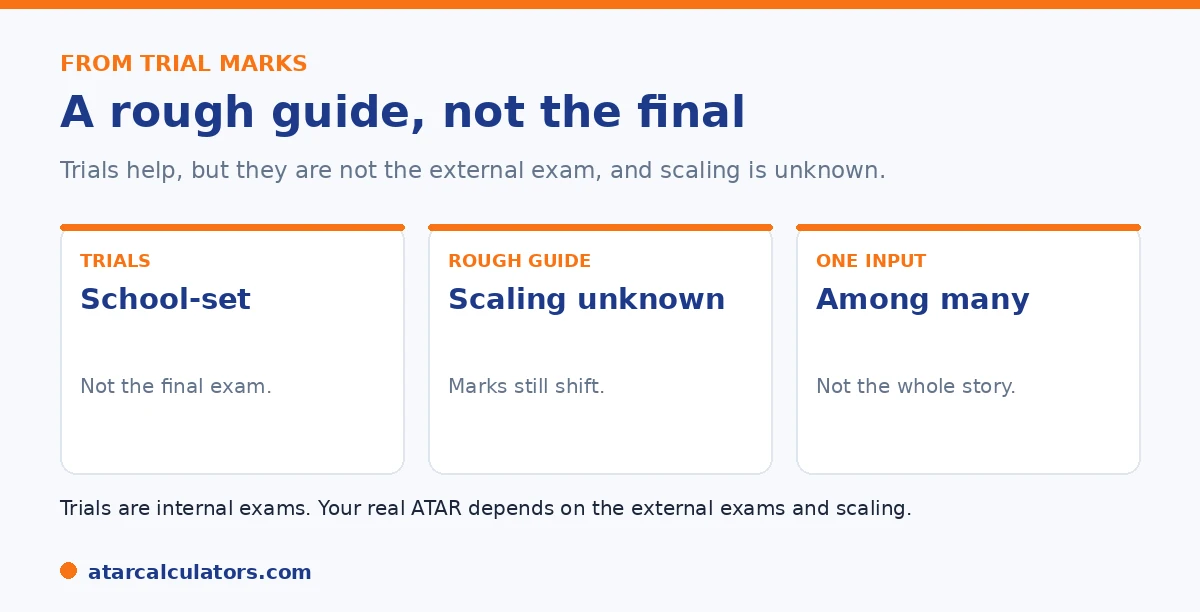
Here is the short version. Trial results are a useful guide to your likely ATAR, but they are not the final word. Trials are internal exams set and marked by your school, not the external exams that count, and the scaling applied to your final results is unknown until afterward. So a trial-based ATAR estimate is genuinely helpful, but it can still move in either direction.
Trials are often the most realistic exams you sit before the real ones, so they are a valuable signal. But reading your final ATAR straight off them can mislead.
Below is how to use trial results sensibly. To estimate from them, use our ATAR predictor.
Key takeaways
- Trials are a useful guide, not the final word.
- They are internal exams, not the external ones.
- The final scaling is unknown until afterward.
- A trial-based ATAR can still move either way.
- Use trials to spot strengths and weak areas.
- There is still time to improve after trials.
Why trials are a useful guide
Trials are valuable because they are close to the real thing. They cover the full course, under exam conditions, often marked to a similar standard. So they give a more realistic signal than earlier assessments.
So if you want an early read on your likely ATAR, trials are one of the best inputs you have before the final exams.
The limits of trial results
But trials have real limits. They are internal exams, set and marked by your school, which can differ from the external exams in style and difficulty. And your trial marks are not yet scaled.
Scaling adjusts subject results when your ATAR is calculated, based on the whole cohort, and it is unknown until afterward. So a trial mark is not a final, scaled result. See our guide on predictor accuracy.
Why a trial-based ATAR can move
Because of those limits, a trial-based ATAR can move in either direction. Students often lift their marks between trials and finals, with focused revision. Others find the external exams play to different strengths.
So treat a trial-based ATAR as a snapshot with room to change, not a locked result. The gap between trials and finals is real preparation time. See our guide on improving your predicted ATAR.
Want to estimate from your trials?
Try the ATAR predictor →Using your trials well
The best use of trials is diagnostic. They show you exactly which topics and skills need work before the finals, while there is still time to act. That is more valuable than the predicted number itself.
So look past the headline ATAR estimate to the detail: where you lost marks, and why. Then build your final revision around that. A trial is a map, not a verdict.
Getting real value from trials comes down to how you read them afterwards. Rather than fixating on the estimated ATAR, go through each paper and sort your lost marks into categories, because the fix differs for each. Marks lost to content you had not learned point to specific topics to revise. Marks lost to careless errors or misreading questions point to exam technique, which is often the fastest thing to improve. Marks lost to running out of time point to pacing and practice under timed conditions. This kind of analysis turns a trial from a source of anxiety into the most useful study tool you have all year, since it tells you exactly where the next hours of revision will pay off most. It also helps to see trials in context: they are usually marked harder than the final exams and sat before your last weeks of preparation, so a trial result is typically a conservative floor rather than a prediction, and students commonly finish above their trial estimate. Use that knowledge to stay calm and motivated. Treat the number as a starting point, mine the papers for the detail of where and why you lost marks, and let that shape a targeted final revision plan.
Common questions
How do I predict my ATAR from trial results?
Enter your trial marks into a predictor for an estimate. It is a useful guide, but remember trials are internal exams, not the external ones, and your marks are not yet scaled, so the estimate can still move.
Are trial marks a good ATAR predictor?
They are one of the better signals before the finals, since they cover the full course under exam conditions. But they are internal exams and unscaled, so treat a trial-based ATAR as a guide, not a final figure.
Why is a trial-based ATAR not final?
Because trials are set and marked by your school, not the external exams that count, and your marks are not yet scaled. Scaling depends on the whole cohort and is unknown until afterward, so the estimate can move.
Can my ATAR improve after trials?
Yes. Many students lift their marks between trials and finals with focused revision, and the external exams can play to different strengths. The gap between trials and finals is real preparation time.
What's the best way to use trial results?
Use them diagnostically. Look at which topics and skills cost you marks, then build your final revision around those gaps. The detail is more useful than the predicted ATAR number itself.
Estimate your ATAR
See an indicative ATAR based on your trial marks. Free, and no signup.
Open the ATAR predictor →Related guides
This guide is general information for students, not formal academic advice. A predicted ATAR is an estimate, not a guarantee. Your real ATAR is calculated from your official examinations and the scaling applied each year. Predictions are less reliable the earlier you make them. Confirm how the ATAR works for your state with your admissions centre, such as UAC, VTAC, QTAC, SATAC or TISC. Reviewed by the ATARCalculators Editorial Team.