Here is the short version. ATAR bonus points, now called adjustment factors, are extra points some universities add to your ATAR to form your selection rank. The main types are subject adjustments, location adjustments for regional students, the Educational Access Scheme for disadvantage, and schemes for elite athletes and performers. Some are automatic, some need an application. They are awarded by each university and vary by course, and your selection rank is capped at 99.95.
Bonus points are one of the most misunderstood parts of university entry. They will not turn an average result into a top one, but they can bridge a real gap.
Below is how they work, the main types, and how to claim them. To estimate yours, use our bonus points calculator.
Key takeaways
- Bonus points are now called adjustment factors.
- They are added to your ATAR to form your selection rank.
- Main types: subject, location, equity (EAS), and talent.
- Some are automatic; others need an application.
- They are set by each university and vary by course.
- Your selection rank is capped at 99.95.
What bonus points are
Bonus points, now officially called adjustment factors, are extra points a university adds to your ATAR. The total becomes your selection rank, which is what the university uses to make offers.
Importantly, they do not change your ATAR. They only lift your selection rank for the courses where you qualify. And they are set by each university, so they differ from one to another.
The four main types
Most bonus points fall into four groups. Here they are at a glance.
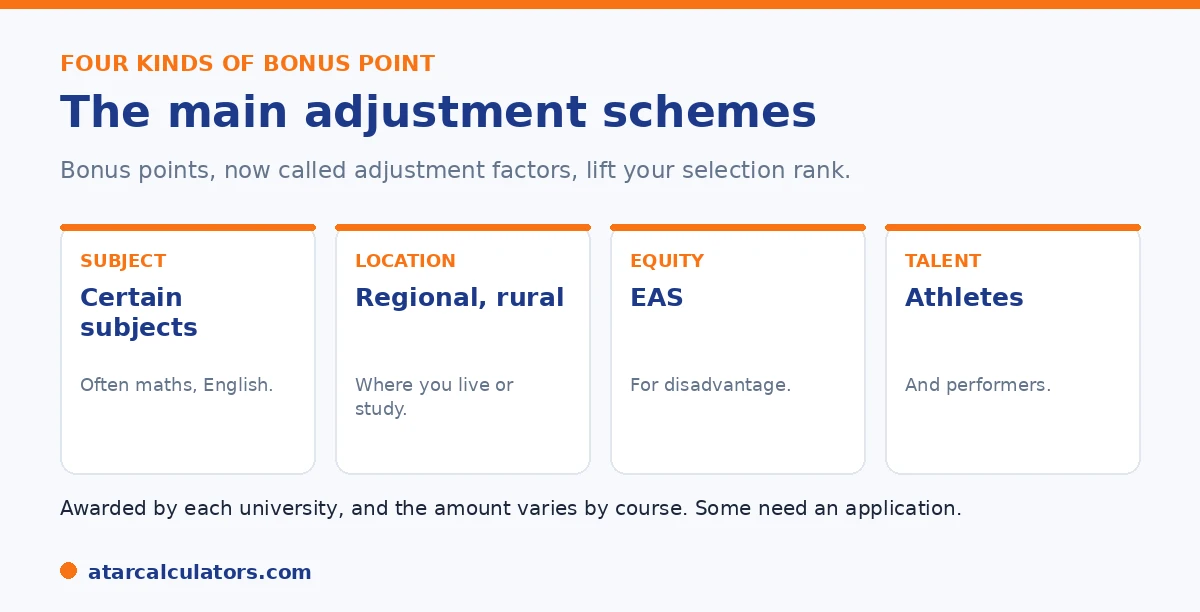
The four are subject adjustments, location adjustments, the Educational Access Scheme, and schemes for elite athletes and performers. We will look at each.
Subject adjustments
Many universities reward strong results in certain subjects. These are often maths and English, or subjects linked to your course, such as a science for an engineering degree.
Subject adjustments are usually added automatically for local Year 12 students. The amount, and which subjects count, vary by university. See our guide on subject bonus points.
Location adjustments
If you live in, or attend school in, a designated regional area, many universities add location adjustments. These are usually automatic, based on your postcode or school.
The rules differ. Some universities use your home address, some your school, and some both. To check, see our guide on regional bonus points.
Want to estimate your bonus points?
Try the bonus points calculator →The Educational Access Scheme
The Educational Access Scheme, or EAS, is for students whose study was affected by hardship during Year 11 or 12. This covers things like money problems, illness or disability, a difficult home life, or disrupted schooling.
Unlike subject and location adjustments, EAS needs a separate application, with documents. It does not guarantee a place, but it can lift your selection rank. See our EAS guide.
Elite athletes and performers
Some universities offer adjustment schemes for elite athletes and performers, recognising the demands of training or rehearsing alongside Year 12. Not every university offers this.
These usually need a separate application, directly to the university or through your admissions centre. See our guide on elite athlete bonus points.
Caps and limits
Bonus points do not stack without limit. Each university caps the total it awards, and the cap varies, often somewhere around 10 to 15 points in total. Within a single scheme, points may not add up either.
On top of that, your selection rank cannot exceed 99.95. See our guide on the maximum bonus points for how stacking works.
Understanding the caps stops two opposite mistakes. The first is assuming you can pile every scheme on top of every other and add fifteen or twenty points to your ATAR; in reality each university sets an overall ceiling, commonly around ten points, and once you reach it, extra eligibility adds nothing. The second is assuming the caps make bonus points barely worth chasing; in the middle of the ATAR range, even a capped total of ten points can move you across several course cut-offs, which is often the difference between your preferred course and a backup. There are usually limits within schemes too: you might get a subject bonus for your best eligible subject but not cumulative points for every qualifying subject, for example. And the 99.95 ceiling means the benefit shrinks as your ATAR rises, so a student on 98 gains far less headroom than one on 85. The sensible approach is to identify every scheme you qualify for, add them up to the university's cap, and then treat that capped total, not an imagined uncapped sum, as your realistic selection-rank boost for that university's courses.
How to claim bonus points
How you claim depends on the type. Subject and location adjustments are usually automatic, so you do nothing. The Educational Access Scheme and elite athlete schemes need a separate application, with documents.
You apply through your state admissions centre: UAC in NSW and the ACT, VTAC in Victoria, QTAC in Queensland, SATAC in South Australia and the Northern Territory, and TISC in Western Australia. Always check each university's own pages too.
Common questions
How do ATAR bonus points work?
Bonus points, now called adjustment factors, are added to your ATAR to form your selection rank, which universities use for offers. The main types are subject, location, equity, and talent schemes. Some are automatic, some need an application.
How many bonus points can I get?
It depends on the university and the schemes you qualify for. Each university caps the total, often around 10 to 15 points, and points within a scheme may not all add up. Your selection rank is also capped at 99.95.
What are adjustment factors?
Adjustment factors are the official name for bonus points. They are extra points a university adds to your ATAR for things like your subjects, where you live, or your circumstances, forming your selection rank for eligible courses.
Do all universities give bonus points?
Most do, but the schemes vary widely. One university may offer a scheme another does not, and amounts differ from one university to another and from course to course. Always check each university directly.
Are bonus points automatic?
Some are. Subject and location adjustments are usually applied automatically for local Year 12 students. The Educational Access Scheme and elite athlete or performer schemes need a separate application, with supporting documents.
Do bonus points change my ATAR?
No. Bonus points do not change your ATAR. They only lift your selection rank for the courses where you qualify. Your ATAR stays fixed once results are released.
Estimate your bonus points
See how many adjustment factors you might get and your likely selection rank. Free, and no signup.
Open the bonus points calculator →Related guides
This guide is general information for students and parents, not formal admissions advice. Adjustment factors, schemes, caps and course cut-offs are set by each university and can change every year. They differ from one institution to another, and from course to course within the same institution. Always confirm the current details with the specific university and your state admissions centre (UAC, VTAC, QTAC, SATAC or TISC). A useful starting point is UAC's guide to selection rank adjustments. Reviewed by the ATARCalculators Editorial Team.