
Here is the short version. To lift your WAM efficiently, focus on high-credit units, since they carry the most weight, aim to cross grade boundaries like 74 to 75, where a small gain matters most, and perform strongly in later years, which often count for more. Where your university allows it, retaking a failed unit can also help. Target your effort rather than spreading it evenly.
Improving your WAM is not just about working harder, but working where it counts. A few smart choices lift your average more than effort spread thinly.
Below are the most effective strategies. To see your current WAM, use our WAM calculator.
Key takeaways
- Focus on high-credit units; they weigh most.
- Aim to cross grade boundaries, like 74 to 75.
- Perform strongly in later years.
- Retaking a failed unit can help, where allowed.
- Target your effort rather than spreading it evenly.
- Small, well-placed gains add up.
Focus on high-credit units
Because your WAM is weighted by credit points, high-credit units have the most influence. A strong mark in a large unit lifts your WAM more than the same mark in a small one. So that is where focused effort pays off most.
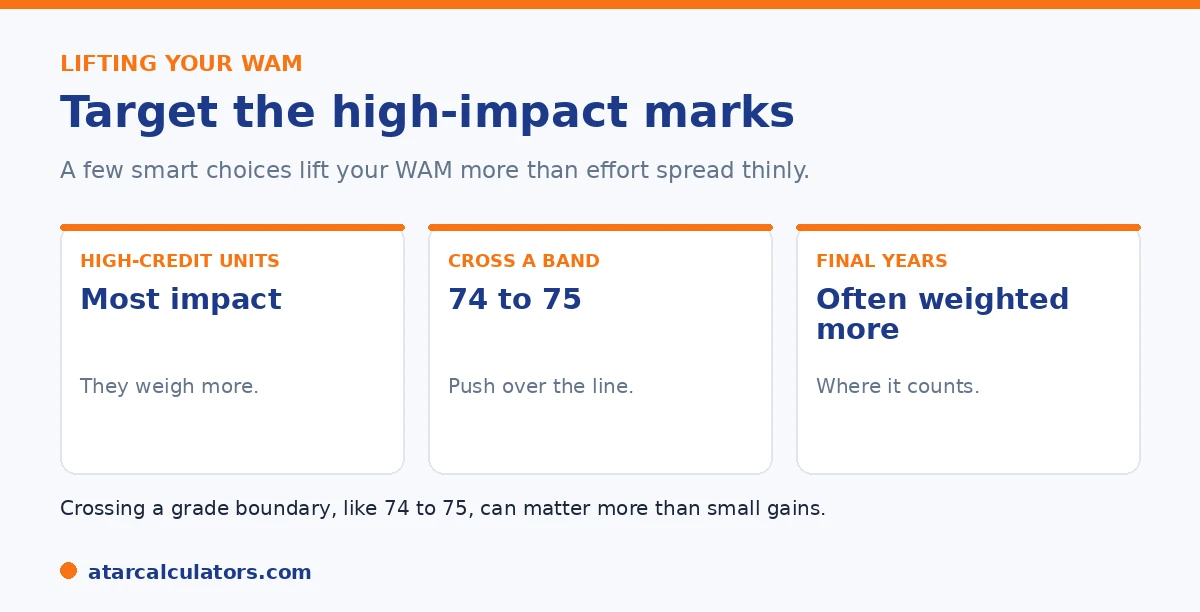
So when you plan your study time, give extra attention to your highest-credit units. They move the needle furthest. See our guide on how WAM is calculated.
Cross grade boundaries
A small gain matters most when it crosses a grade boundary. Lifting a mark from 74 to 75 moves you from Credit to Distinction, which can matter for grade-based purposes, and every extra mark lifts your WAM directly.
So if a unit is sitting just below a boundary, a little extra effort there can be very efficient. Identify your near-miss units and target them. See our guide on what counts as a good WAM.
This is the single most efficient WAM strategy, because the payoff is concentrated where you are already close. A student sitting on 64, 74 or 84 in a unit is one mark from the next grade band, so a modest push there is far better value than the same effort spread across units where you are comfortably mid-band. The way to use this is to look at your predicted marks near the end of session and pick out the units hovering a point or two below a boundary, then concentrate your remaining revision and assessment effort on those. It matters most in two situations: for GPA purposes, where crossing a boundary changes your grade points and can visibly lift your GPA, and near the honours or graduation thresholds, where a single boundary can decide which classification you get. The trap to avoid is over-investing in a unit you have already secured, or one that is hopelessly out of reach; the marginal mark is worth chasing precisely when it changes something. Combine this with focusing on your highest-credit units and you are directing effort exactly where it moves your WAM most.
Want to see your WAM?
Try the WAM calculator →Perform strongly in later years
At many universities, later-year units are weighted more heavily than first-year ones. So strong marks in your final years count for more toward your WAM than the same marks earlier.
This is encouraging if your first year was rocky: your later results can carry more weight. So finishing strongly can lift your WAM meaningfully. Check whether your university uses year weighting. See our guide on why a WAM can drop.
Retaking a failed unit
If you have failed a unit, retaking and passing it can lift your WAM, because some universities replace the fail mark with the new result. This can give an immediate boost by removing a low mark.
Policies on grade replacement vary, so check yours before re-enrolling. Where it applies, it is one of the most direct ways to recover a WAM hit. See our guide on how WAM is calculated.
Common questions
How do I boost my WAM?
Focus on high-credit units, which carry the most weight, aim to cross grade boundaries like 74 to 75, perform strongly in later years, which often count for more, and retake failed units where your university allows grade replacement.
Can I raise my WAM in my final year?
Yes, often more than you might expect. Many universities weight later-year units more heavily, so strong final-year marks count for more. Finishing strongly can lift your WAM meaningfully, even after a rocky start.
Does retaking a unit improve my WAM?
It can. Some universities replace a failed unit's mark with the new result when you retake and pass, giving an immediate boost. Policies on grade replacement vary, so check yours before re-enrolling.
Why focus on high-credit units?
Because your WAM is weighted by credit points, so high-credit units have the most influence. A strong mark in a large unit lifts your WAM more than the same mark in a small one, making it the most efficient focus.
Does crossing a grade boundary matter for WAM?
Every extra mark lifts your WAM directly, and crossing a boundary like 74 to 75 also moves you from Credit to Distinction. So targeting units sitting just below a boundary can be a very efficient use of effort.
See your WAM
Add your units and marks to see your WAM and test improvements. Free, and no signup.
Open the WAM calculator →Related guides
This guide is general information for students, not formal academic advice. WAM and GPA policies, grade bands and honours thresholds vary by university and faculty, and can change. Failed units, year weighting and which units count are all set by each university. Always confirm with your own university's official grading and WAM policy, such as the University of Sydney or your own institution. Reviewed by the ATARCalculators Editorial Team.