Here is the short version. Your ATAR is your fixed rank, from 0.00 to 99.95, showing your position in your cohort. Your selection rank is your ATAR plus any adjustment factors, once called bonus points, and it is what universities actually use to make offers. So your selection rank can be higher than your ATAR. It can also differ from course to course, because each university sets its own adjustment schemes. Adjustment factors do not change your ATAR.
Many students think the ATAR is the number universities use to make offers. It is not, quite. Universities use your selection rank, which is usually a little different.
Below is exactly how the two relate, and why it matters. To estimate your selection rank, use our selection rank calculator.
Key takeaways
- Your ATAR is your fixed rank, from 0.00 to 99.95.
- Your selection rank is your ATAR plus adjustment factors.
- Selection rank is what universities use to make offers.
- It can be higher than your ATAR, and never above 99.95.
- It can differ by course, since schemes vary by university.
- Adjustment factors do not change your ATAR.
What your ATAR is
Your ATAR, the Australian Tertiary Admission Rank, is a number from 0.00 to 99.95. It is a rank, not a mark. It shows your position compared with other students in your cohort. An ATAR of 80.00 means you are about top 20 per cent.
Your ATAR is fixed once results are released. Nothing you do during applications changes it. It is the starting point, not the finish line.
What your selection rank is
Your selection rank is your ATAR plus any adjustment factors you qualify for. Adjustment factors, once called bonus points, are extra points some universities add for things like your subjects, where you live, or your circumstances.
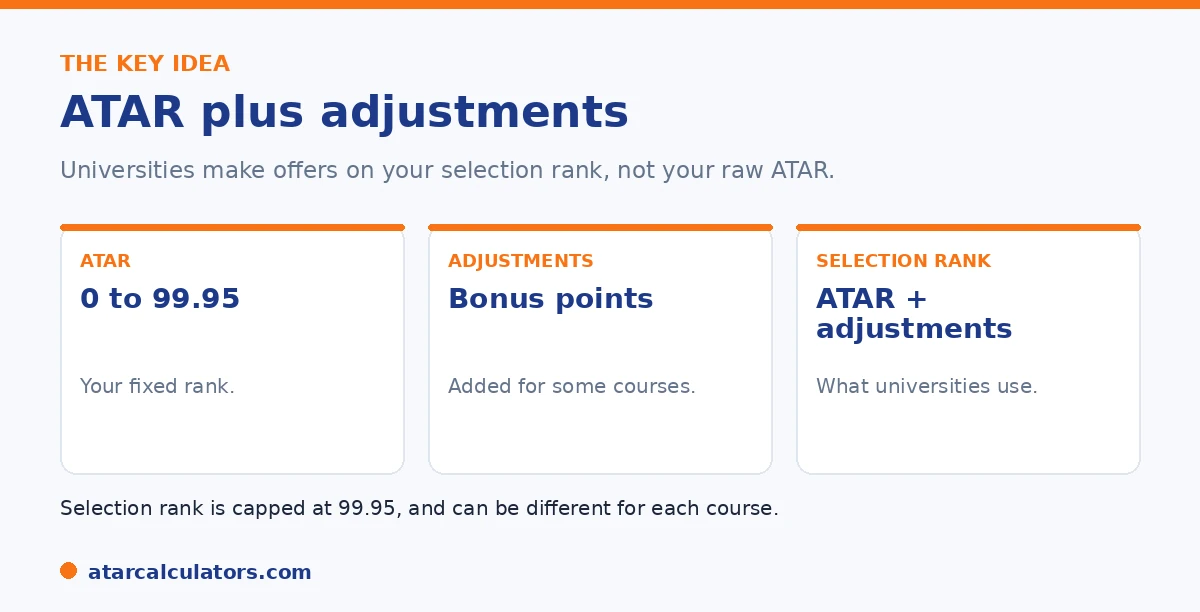
Your selection rank is the number a university actually uses to decide your offer. Because adjustments are added on top, your selection rank is often higher than your ATAR.
The key difference
So the difference is simple. Your ATAR is your raw rank. Your selection rank is your ATAR plus adjustments, and it is what gets you the offer.
The important point is that adjustments do not change your ATAR. Your ATAR stays the same. The adjustments only lift your selection rank for the courses where you qualify.
Want to see your likely selection rank?
Try the selection rank calculator →Your selection rank can differ by course
Here is a part many students miss. Your selection rank is not one fixed number. It can be different for each course you apply to.
That is because every university sets its own adjustment schemes, and often different schemes for different courses. So the same student can have one selection rank for a course at one university and a different one elsewhere. Your ATAR, by contrast, stays the same everywhere.
Course cut-offs are selection ranks
This also explains course cut-offs. When a university publishes a cut-off, it is usually the lowest selection rank that got an offer, not a raw ATAR. So you can sometimes get in with an ATAR below the published cut-off, if adjustments lift your selection rank.
For more on this, see our guide to selection rank cut-offs.
This single fact changes how you should read every cut-off you see, so it is worth dwelling on. A published cut-off is the selection rank of the last student admitted, and because selection ranks include adjustment factors, that student may well have had an ATAR below the figure quoted. In other words, the "cut-off" is not the minimum ATAR; it is the minimum adjusted rank. The practical consequences are real. First, do not rule out a course just because your raw ATAR sits a point or two under its published cut-off, because your adjustments might carry you over. Second, do not assume your raw ATAR being above the cut-off guarantees a place, since the cut-off can rise year to year with demand, and other applicants bring their own adjustments. Third, when you compare yourself to a cut-off, compare like with like: your selection rank for that course against that course's cut-off, not your bare ATAR against a number that already has adjustments baked in. Read this way, a published cut-off becomes a useful planning tool rather than a hard wall, and students who understand it apply more widely and more accurately than those who treat the ATAR figure as final.
The 99.95 cap
One limit applies. Your selection rank cannot go above 99.95, the maximum ATAR. Adjustments can lift you toward it, but never past it.
So a student with a high ATAR has less room for adjustments to help, while a student a little below a cut-off may find adjustments bridge the gap. To see how the rank is built, see our guide on how selection rank is calculated.
Common questions
What is the difference between selection rank and ATAR?
Your ATAR is your fixed rank from 0.00 to 99.95. Your selection rank is your ATAR plus any adjustment factors, and it is what universities use to make offers. So your selection rank can be higher than your ATAR.
Is selection rank the same as ATAR?
No. They are the same only if you get no adjustment factors. Otherwise your selection rank is your ATAR plus those adjustments, which is what a university actually uses to decide your offer.
Can a selection rank be higher than an ATAR?
Yes. Adjustment factors are added to your ATAR to form your selection rank, so it is often higher. It cannot go above 99.95, the maximum, and the adjustments do not change your ATAR itself.
Why does my selection rank change between courses?
Because each university sets its own adjustment schemes, often different ones for different courses. So your selection rank can differ from course to course, even though your ATAR stays the same everywhere.
Do adjustment factors change my ATAR?
No. Adjustment factors do not change your ATAR. They only change your selection rank for the courses where you qualify. Your ATAR remains fixed once results are released.
Is a course cut-off an ATAR or a selection rank?
Usually a selection rank. A published cut-off is normally the lowest selection rank that got an offer, not a raw ATAR. So you can sometimes get in with an ATAR below the cut-off if adjustments lift your rank.
Estimate your selection rank
Add your ATAR and any adjustments to see your likely selection rank. Free, and no signup.
Open the selection rank calculator →Related guides
This guide is general information for students and parents, not formal admissions advice. Adjustment factors, schemes, caps and course cut-offs are set by each university and can change every year. They differ from one institution to another, and from course to course within the same institution. Always confirm the current details with the specific university and your state admissions centre (UAC, VTAC, QTAC, SATAC or TISC). A useful starting point is UAC's guide to selection rank adjustments. Reviewed by the ATARCalculators Editorial Team.