Here is the short version. Many universities add bonus points, called location adjustments, if you live in or attend school in a designated regional area. They are usually automatic, based on your postcode or your school, so you often do not need to apply. The designated regions and the points vary by university. Some use your home address, some your school, and some both. So check the specific university and your state admissions centre.
Regional bonus points are one of the most accessible boosts, because they are usually automatic. The catch is knowing whether your postcode or school counts.
Below is how they work, and how to check yours. To estimate your selection rank, use our regional points calculator.
Key takeaways
- Many universities add points for regional students.
- They are based on your postcode or your school.
- They are usually automatic, so you may not need to apply.
- Designated regions and points vary by university.
- Some use your home address, some your school, some both.
- Check the university and your state admissions centre.
How regional bonus points work
Regional bonus points are a kind of location adjustment. If you live in, or attend school in, a designated regional area, many universities add points to lift your selection rank.
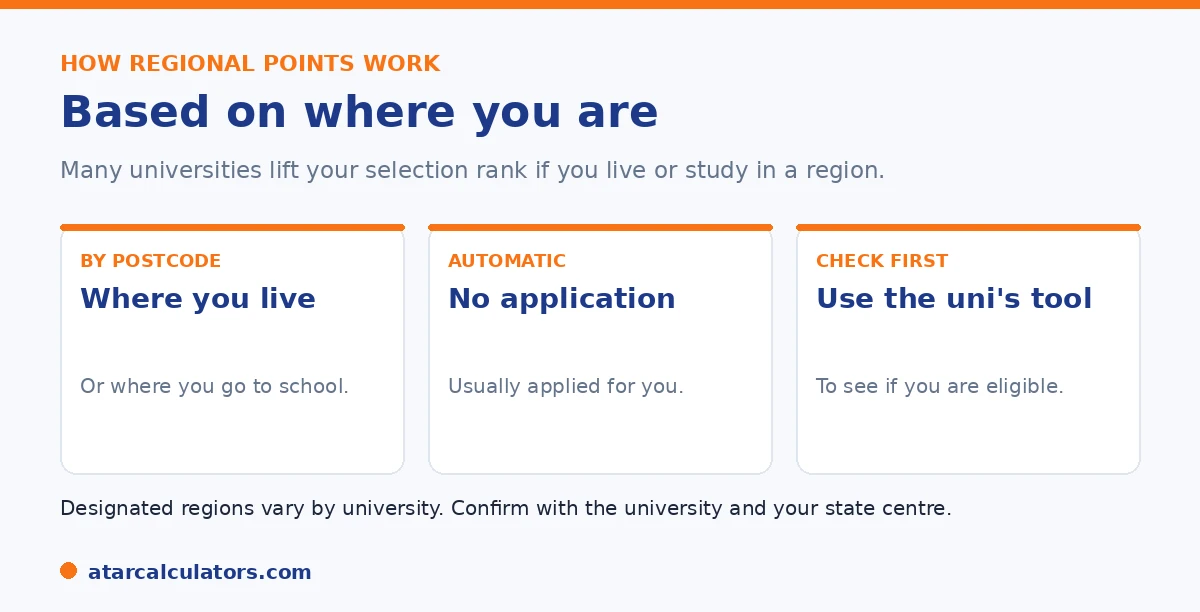
The aim is to recognise that students outside major cities can face extra barriers to university. The points help level the field a little.
Based on postcode or school
Eligibility is usually based on either your home postcode, your school's location, or both. This is where universities differ. Some look at where you live, some at where you go to school, and some at both.
So a student might qualify at one university but not another, depending on which rule each uses. It is worth checking both your home postcode and your school against each university's criteria.
This postcode-or-school distinction is the detail that catches students out, so it pays to understand it and check carefully. A university that assesses eligibility on your home address rewards where you actually live, using a list of qualifying rural and remote postcodes measured against a national geographic classification, often with a minimum period of residence. A university that assesses on school location instead rewards students who attended a school in a regional or remote area, which can help a student who lives just inside a city boundary but was schooled regionally, or the reverse. Some use both, and some let you qualify on either. The practical upshot is that the same student can qualify at one university and miss out at another purely because of which rule is applied, so a blanket assumption that you "do" or "do not" get regional points is unreliable. The sensible approach is to take your home postcode and your school, and check each against the specific criteria of every university you are applying to, rather than relying on a single answer. Where residence periods apply, keep evidence of your address history, since eligibility often depends on how long you lived at a qualifying location. And remember that regional points, however you qualify, feed your selection rank rather than your ATAR and combine with other adjustments up to each university's cap, so their value is greatest in the middle of the range and close to a course cut-off.
Usually automatic
The good news is that location adjustments are usually applied automatically. You generally do not need to lodge a separate application; the admissions centre and university work it out from your details.
That said, it is wise to confirm the points have been applied, especially if you are unsure your area qualifies. If something looks wrong, contact the university. See our guide on how much regional points are worth.
Want to estimate your selection rank?
Try the regional points calculator →How to check your postcode
Because there is no single national list, the reliable way to check is at the source. Most universities and admissions centres have a tool or list where you can enter your postcode or school to see if you qualify.
Check each university you are interested in, since the designated regions differ. Do not assume that qualifying at one means qualifying at all. Your state admissions centre is a good starting point.
Stacking with other adjustments
Regional points can usually be combined with other adjustments, such as subject points or the Educational Access Scheme. Together, these stack toward your selection rank, up to the university's cap.
So regional points are rarely the whole story. They often add to other boosts you qualify for. See our guide on stacking regional and equity points.
Common questions
What postcodes get regional bonus points?
Those in areas a university designates as regional. There is no single national list, because each university sets its own designated regions. Check your postcode against each university's tool or your state admissions centre.
Is my postcode eligible for regional bonus points?
It depends on the university. Some base eligibility on your home postcode, some on your school's location, and some on both. Check both against each university's criteria, since the designated regions vary.
How do I check if my postcode qualifies?
Use the tool or list provided by each university or your state admissions centre, entering your postcode or school. Check each university you are interested in, since the designated regions differ from one to another.
Do I need to apply for regional bonus points?
Usually not. Location adjustments are generally applied automatically, based on your postcode or school. It is still wise to confirm the points have been applied, and to contact the university if something looks wrong.
Do regional points depend on my home or my school?
It varies by university. Some use your home address, some your school's location, and some both. So check both, since you might qualify under one rule but not another at a given university.
Can I combine regional points with other adjustments?
Usually, yes. Regional points can stack with other adjustments, such as subject points or the Educational Access Scheme, up to the university's total cap, and your selection rank cannot exceed 99.95.
Estimate your selection rank
See how regional points could change your selection rank. Free, and no signup.
Open the regional points calculator →Related guides
This guide is general information for students and parents, not formal admissions advice. Adjustment factors, schemes, caps and course cut-offs are set by each university and can change every year. They differ from one institution to another, and from course to course within the same institution. Always confirm the current details with the specific university and your state admissions centre (UAC, VTAC, QTAC, SATAC or TISC). A useful starting point is UAC's guide to selection rank adjustments. Reviewed by the ATARCalculators Editorial Team.