VCE Legal Studies tends to scale down slightly, because it is a popular, content-dense subject with a broad cohort. VTAC scales your raw study score against the cohort, and the scaled score, not the raw one, feeds your ATAR. So a strong Legal Studies score contributes a little below face value. But scaling only helps if you score well, so aim to score as high as you can. The exact figures change each year, so check VTAC’s scaling report.
Key takeaways
- Legal Studies tends to scale down slightly.
- It is a popular, content-dense subject.
- The scaled score, not the raw one, feeds your ATAR.
- Scaling figures vary yearly — check VTAC.
- The average study score is 30.
- Choose it for fit, not just scaling.
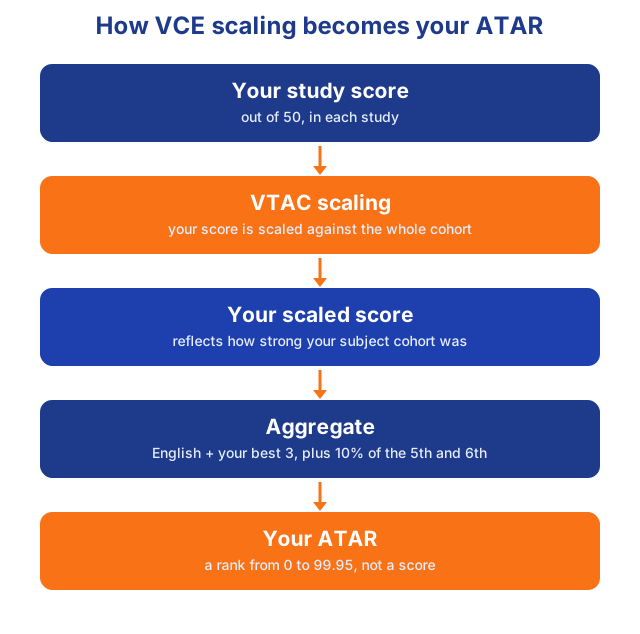
How VTAC scaling works
In the VCE, you get a study score out of 50 for each Unit 3 and 4 subject. VTAC then scales that score. Scaling adjusts each subject so scores from different subjects can be compared fairly.
The scaling is based on how strong a subject’s students are across all their subjects. It is done by VTAC, not your school. Your scaled scores then feed into your ATAR.
Does VCE Legal Studies scale up or down?
VCE Legal Studies tends to scale down slightly, because it is a popular, content-dense subject with a broad cohort, so it tends to scale down slightly. Scaling reflects the strength of a subject’s cohort, not how hard the subject feels.
This is a tendency, not a fixed rule. The exact scaling changes each year with the cohort. So treat any general statement as a guide, and check VTAC’s latest scaling report for the current figures.
Why it scales this way
Scaling rewards subjects whose students are strong across their whole program. A score in such a subject represents a higher standard. Legal Studies scales down slightly because it is a popular, content-dense subject with a broad cohort, so it tends to scale down slightly.
So scaling is not a judgement on how hard a subject is to study. It reflects who takes it. A subject can feel demanding and still scale modestly, or feel manageable and scale up.
The study score explained
A study score is out of 50 for each Unit 3 and 4 sequence. By design, the average study score each year is set to 30. About two thirds of students score between roughly 23 and 37.
A study score of 40 or above is roughly the top 9 per cent, and 45 or above is exceptional. These figures are set by the scaling process, so use them as a guide and check VTAC for the current detail.
Raw vs scaled study score
Your raw study score is the one you earn in the subject. Your scaled study score is what it becomes after VTAC scaling. The scaled score can be higher or lower than the raw score.
It is the scaled study score, not the raw one, that counts toward your ATAR. So when people ask how Legal Studies scales, they are asking how far your raw score moves once scaled. Check VTAC’s scaling report for the exact figures.
From study score to ATAR
Your ATAR aggregate is built from your scaled study scores. It adds your best four studies, your “primary four”, which must include an English. It then adds 10 per cent of your fifth and sixth scores, if you have them.
VTAC then converts your aggregate into an ATAR, which is a rank. So your ATAR comes from your whole set of subjects, not from Legal Studies alone.
What a strong score contributes
There is no fixed ATAR that a single Legal Studies score produces. Your ATAR comes from your scaled scores across all your subjects combined. So a strong Legal Studies score contributes to your ATAR, but does not set it.
Because Legal Studies scales down slightly, a given raw score contributes a little below face value. But how much it lifts your ATAR still depends on your other subjects. See what a good Legal Studies score is.
Should you pick Legal Studies for scaling?
Choosing a subject mainly for scaling is usually a mistake. Scaling only helps if you score well. A subject that scales up but that you struggle in gains you little.
A subject that suits you can give a strong scaled score even if its scaling is modest. So choose Legal Studies for your strengths, interests and goals, not its scaling. See whether Legal Studies is worth taking.
Lifting your study score
Scaling follows your performance. To lift your scaled score in Legal Studies, you need to lift your study score. That means strong SACs and a strong exam.
So focus on your rank in the subject: master the content, practise past exams, and act on examiner reports. A higher study score flows straight through scaling into a higher scaled score.
Estimate your Legal Studies scaling
To see roughly how a Legal Studies score scales, use our VCE Legal Studies scaling calculator. It gives an indication of how a raw score scales, so you can see how the subject fits your ATAR.
Treat the result as indicative. Scaling changes each year, and your study score is what your scaled score depends on.
How Legal Studies compares to other subjects
Compared with other VCE subjects, Legal Studies scales down slightly. Maths and science subjects with strong cohorts tend to scale up, while broad, popular subjects tend to scale down. Most sit somewhere in between.
So Legal Studies’s scaling reflects where its cohort sits, not its difficulty. This is useful context, but it should not push you toward or away from the subject on its own. Your own score matters more than the subject’s scaling.
A common scaling myth
A common myth is that choosing Legal Studies for its scaling will lift your ATAR no matter how you do. This is false. Scaling only helps if you score well. A subject you struggle in gains you little, whatever its scaling.
So the myth confuses a subject’s scaling with what you personally get from it. What you get depends on your score. A subject you can do well in serves you better than one you pick only for scaling.
Legal Studies and your primary four
Your ATAR aggregate uses your best four scaled scores, your primary four, plus 10 per cent of your fifth and sixth. So a subject helps most when it is one of your best four.
If Legal Studies is among your strongest subjects, its scaled score counts in full. If it is your fifth or sixth, only 10 per cent counts. So how much Legal Studies helps depends partly on how it ranks among your subjects.
Why English is always counted
One of your primary four must be an English subject. Every VCE student must complete an English study, and it always counts toward your aggregate. So English sits alongside Legal Studies and your other subjects in your best four.
This does not change how Legal Studies scales. But it is worth knowing that English is always in the mix, so your other strong subjects, including Legal Studies if it is one, fill the remaining places.
Using scaling in your planning
The sensible way to use scaling is as context, not a rule. Know roughly how Legal Studies scales, but base your choice on your strengths, interests and goals. Then focus your effort on scoring as high as you can.
So let scaling inform your understanding without driving your choices. A strong score in a subject that suits you is the reliable path to a good scaled score, whatever the scaling that year.
Where your raw study score comes from
Your raw study score reflects your rank in the subject, set by your SACs and exam together. VTAC works out where you sit among all Legal Studies students, then expresses that as a score out of 50.
So your raw score is really your rank, written as a number. This is why scaling can then adjust it: it compares that rank fairly against other subjects.
Scaling only helps if you score
It is worth repeating: scaling only helps if you score well. A high-scaling subject with a low score still gives a low scaled score. A modest-scaling subject with a high score can give you more.
So your score comes first, and scaling second. Chase the score in Legal Studies, and let scaling do its work on top.
Common questions
Does VCE Legal Studies scale up or down?
VCE Legal Studies tends to scale down slightly, because it is a popular, content-dense subject with a broad cohort, so it tends to scale down slightly. This is a tendency, not a fixed rule, and the exact scaling changes each year with the cohort. Check VTAC’s latest scaling report for the current figures.
How does the VCE Legal Studies study score convert to an ATAR?
VTAC scales your raw Legal Studies study score against the cohort. Your scaled scores are then added into your aggregate, your best four studies plus 10 per cent of your fifth and sixth, and VTAC converts that aggregate into your ATAR.
What is the scaled study score for Legal Studies?
The scaled study score is your raw Legal Studies study score after VTAC scaling, and it is the one that counts toward your ATAR. It can be higher or lower than your raw score, and it changes each year, so check VTAC’s scaling report for the exact figures.
What ATAR contribution does a strong Legal Studies score give?
There is no fixed ATAR from a single subject. Your ATAR comes from your scaled scores across all subjects combined, so a strong Legal Studies score contributes to your ATAR but does not set it by itself. Because Legal Studies scales down slightly, a given raw score contributes a little below face value.