HSC Maths Extension 1 tends to scale well, because it attracts a strong maths cohort taking an additional, harder course, and scaling reflects the strength of a subject’s students across their whole program. Your Extension 1 mark is scaled by UAC against the cohort and combined into your aggregate, which is ranked into your ATAR. Scaling acts on your rank within the subject, so the surest way to a strong scaled mark is to rank as high as you can. The exact scaled mean changes each year, so check UAC’s scaling report.
Key takeaways
- Maths Extension 1 tends to scale well.
- Scaling reflects its strong maths cohort.
- Scaling acts on your rank within the subject.
- The scaled mean varies yearly — check UAC.
- A Band E4 is the top band for extension.
- Choose it for fit and pathways, not just scaling.
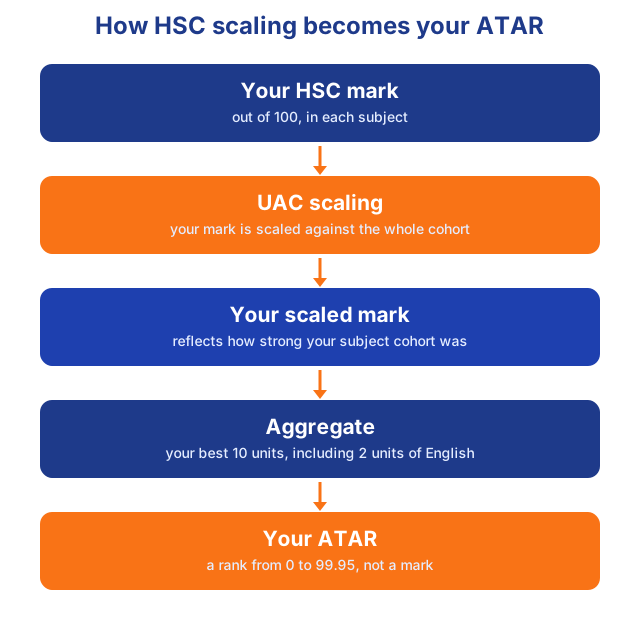
How HSC scaling works
In the HSC, your mark in each subject is scaled by UAC against the whole state cohort for that subject. The scaled marks from your best units are combined into an aggregate, and that aggregate is ranked to produce your ATAR.
So scaling is the step that makes marks from different subjects comparable, before they are added up. It is done by UAC, not by your school or by NESA, and it happens after your HSC marks are finalised. See how scaling works.
The key point is that your raw performance is converted twice: first into an HSC mark, then into a scaled mark for the ATAR. It is the scaled mark, and your rank behind it, that feeds your ATAR.
Does HSC Maths Extension 1 scale up or down?
HSC Maths Extension 1 tends to scale well, because it attracts a strong maths cohort taking an additional, harder course, and scaling reflects the strength of a subject’s students across their whole program. Scaling reflects how strong the students taking a subject are across all their subjects, not how hard the subject feels.
So Maths Extension 1 scales well on average, but this is a tendency, not a fixed rule. The exact scaling changes from year to year with the cohort, so treat any general statement as a guide and check the current figures. See best scaling subjects in NSW.
Why it scales this way
The reason comes down to the cohort. Scaling rewards subjects whose students are strong across their whole program, because a mark in such a subject represents a higher standard. Maths Extension 1 scales well because it attracts a strong maths cohort taking an additional, harder course, and scaling reflects the strength of a subject’s students across their whole program.
This is why scaling is not a judgement on how hard a subject is to study. It reflects who takes it, so a subject can feel demanding and still scale modestly, or feel manageable and scale well, depending on its cohort.
The scaled mean
People often ask for the exact scaled mean of Maths Extension 1, the average scaled mark for the subject. This is published by UAC in its scaling report each year, and it changes annually with the cohort, so there is no single fixed figure to quote.
So rather than rely on a number that may be out of date, check UAC’s most recent scaling report for the current scaled mean. What matters more for you is your rank within the subject, since that is what your scaled mark depends on.
Scaling acts on your rank
The most important thing to understand is that scaling acts on your rank within the subject. Your position relative to the other students taking Maths Extension 1 determines your scaled mark, not your raw mark on its own.
So your goal is to rank as high as you can in Maths Extension 1. Scaling then lifts or lowers the whole subject, but it never changes your position within it. A strong rank always produces a stronger scaled mark, whatever the subject’s overall scaling.
What ATAR does an E4 in Maths Extension 1 give?
There is no fixed ATAR that an E4 in Maths Extension 1, or any single subject, produces. Your ATAR comes from your scaled marks across all your subjects combined, not from one subject’s band. So an E4 in Maths Extension 1 contributes to your ATAR, but does not set it by itself.
An E4 is a strong result that scales into a solid scaled mark, more so in higher-scaling subjects. But because your ATAR depends on your whole combination of subjects, the same band contributes differently depending on the rest of your results. See what an E4 in Maths Extension 1 means.
How your mark becomes an ATAR
Step by step: your Maths Extension 1 exam mark is aligned to a band, and averaged with your moderated school assessment mark to give your HSC mark. UAC then scales that performance against the cohort, producing a scaled mark. Your best scaled marks are added into an aggregate, which is ranked into your ATAR.
So there are several steps between your exam and your ATAR, and scaling is one of them. This is why your ATAR is not simply your average HSC mark: the scaling and ranking in between are what turn subject marks into a single rank.
Should you choose Maths Extension 1 for scaling?
Choosing a subject mainly for its scaling is usually a mistake. Because scaling acts on your rank, a subject only scales well for you if you can rank well in it. A high-scaling subject you struggle in gains you nothing, while a subject that suits you can produce a strong scaled mark even if its overall scaling is modest.
So choose Maths Extension 1 because it suits your strengths, interests and goals, not just its scaling reputation. See whether you should take Maths Extension 1 for a fuller look.
Lifting your scaled mark
Because scaling follows your rank, the way to lift your scaled mark in Maths Extension 1 is to lift your rank. That means strong internal assessments and a strong exam, since together they set your position in the cohort.
So focus on ranking as high as you can: master the content, practise past papers, and sharpen your exam technique. A better rank flows straight through scaling into a better scaled mark, whatever the subject’s overall scaling that year.
Estimate your Maths Extension 1 scaling
To see roughly how your Maths Extension 1 mark scales, use our HSC Maths Extension 1 scaling calculator. It gives an indication of how a given mark scales, so you can see how the subject fits into your ATAR.
Treat the result as indicative, since scaling changes each year, and remember your rank is what your scaled mark really depends on. For the full method, see how scaling works.
Raw marks vs aligned marks
Before scaling even happens, your raw exam mark in Maths Extension 1 is aligned to the HSC band scale by NESA, which adjusts for the difficulty of each year’s paper. So your raw mark and your HSC mark are not the same thing, and neither is your scaled mark.
So there are two separate adjustments: alignment by NESA to produce your HSC mark, and scaling by UAC to produce your scaled mark for the ATAR. Keeping these distinct helps make sense of how your exam performance becomes an ATAR.
How Maths Extension 1 compares to other subjects
Compared to other HSC subjects, Maths Extension 1 scales well. The physical sciences and higher maths tend to scale strongly, humanities subjects around the middle, and very broad subjects lower, all reflecting their cohorts rather than their difficulty.
So Maths Extension 1’s scaling sits where its cohort places it. This is worth understanding for context, but it should not push you toward or away from the subject on its own, since your rank matters more than the subject’s overall scaling. See best scaling subjects in NSW.
A common scaling myth
A common myth is that choosing Maths Extension 1 for its scaling will lift your ATAR regardless of how you do. This is false. Because scaling acts on your rank, a high-scaling subject you rank poorly in gains you nothing, and can hurt your ATAR.
So the myth confuses a subject’s average scaling with what you personally get from it. What you get depends on your rank, so a subject you can excel in serves you better than a higher-scaling one you struggle in.
Using scaling in your planning
The sensible way to use scaling information is as context, not a decision rule. Know roughly how Maths Extension 1 scales, but base your choice on your strengths, interests and goals, and focus your effort on ranking as high as you can.
So let scaling inform your understanding without driving your choices. A strong rank in a subject that suits you is the reliable path to a good scaled mark, whatever the subject’s overall scaling that year.
Common questions
Does HSC Maths Extension 1 scale up or down?
HSC Maths Extension 1 tends to scale well, because it attracts a strong maths cohort taking an additional, harder course, and scaling reflects the strength of a subject’s students across their whole program. This is a tendency, not a fixed rule, and the exact scaling changes each year with the cohort, so check UAC’s current scaling report.
How do HSC Maths Extension 1 marks convert to an ATAR?
Your Maths Extension 1 mark is scaled by UAC against the cohort, and your best scaled marks are combined into an aggregate that is ranked into your ATAR. So the scaled mark, and your rank behind it, feed your ATAR, not your raw mark alone.
What is the scaled mean for Maths Extension 1?
The scaled mean for Maths Extension 1 is the average scaled mark for the subject, published by UAC in its scaling report each year. It changes annually with the cohort, so there is no single fixed figure; check UAC’s latest report for the current value.
What ATAR does an E4 in Maths Extension 1 give?
There is no fixed ATAR from a single subject’s band. Your ATAR comes from your scaled marks across all subjects combined, so an E4 in Maths Extension 1 contributes to your ATAR but does not set it by itself.